AfL strategies: a practical list for primary and secondary
AfL strategies for UK classrooms: the five key strategies, with a primary and a secondary example for each, and how to run them without extra marking.
LearnWorkly team7 min read

Most UK teachers have sat through an INSET session on assessment for learning. Many came away with a pile of laminated traffic-light cards and a vague sense that AfL meant writing WALT on the board. The research behind it is more useful than that. Assessment for learning strategies, or AfL strategies for short, are five habits that let you find out what pupils understand during the lesson, and change what you do next because of it.
This list takes each of the five key strategies in turn and gives two AfL examples, one primary and one secondary, that you could try tomorrow. Each section ends with a note on keeping the workload down, because a strategy that adds an hour of marking a night will not last until February half term.
Where the five AfL strategies come from
The term grew out of work by Paul Black, Dylan Wiliam and the Assessment Reform Group in the late 1990s. If you want the background on formative assessment itself, our plain guide to formative assessment covers it, so this post goes straight to practice.
In a short 2006 article, Assessment for learning: why, what and how?, Wiliam sums up the big idea: evidence about what pupils have learnt is used to adapt teaching to their needs. He lists five key strategies:
- Clarifying and sharing learning intentions and success criteria with learners
- Engineering effective classroom discussions, activities and tasks that elicit evidence of student achievement
- Providing feedback that moves learners on
- Activating students as owners of their own learning (self-assessment)
- Activating students as instructional resources for one another (peer assessment)
He also writes that focusing on any one of the five is effective on its own. That matters for a busy teacher. You do not need all five at once.
AfL strategies in practice: primary and secondary examples
1. Learning intentions and success criteria
The aim is that pupils know what they are learning and what a good piece of work looks like before they start. A learning intention copied into books at the start of every lesson rarely does that. Showing what good looks like does.
Primary (Year 4 writing). Before pupils write a setting description, put two short paragraphs side by side on the board. One is flat, the other uses expanded noun phrases and a simile. Ask the class what the second one does that the first does not. Write their answers up as the success criteria, in their words.
Secondary (Year 10 science). Before a six-mark question on osmosis, show three anonymous answers from last year scoring 2, 4 and 6 marks. Pairs rank them and say what separates each one from the next. The mark scheme now means something to them.
Workload: build the criteria once and reuse them for the unit. If you mark against them later, use the same words so pupils can see the link.
2. Discussion and questioning
This strategy is about questions and tasks that show you what every pupil thinks, rather than what the three keenest hands think. A single well-built question can tell you more than ten quick ones.
Primary (Year 2 maths). Ask: “Which is bigger, 1/3 or 1/4?” Every pupil writes an answer on a mini whiteboard and holds it up on your count of three. If a cluster of boards say 1/4 “because 4 is bigger than 3”, you know exactly what to reteach, and you know it in the first ten minutes.
Secondary (Year 8 history). Ask a multiple-choice question where every option is a reason pupils often give. “What mattered most in William’s win at Hastings?” with options for luck, Harold’s tired army, the feigned retreat and better weapons. Pupils commit to one, then defend their choice in pairs before you say anything.
Marking load: none. The evidence is visible in the room, and you act on it straight away. Write the one or two hinge questions into your plan so you don’t have to invent them on the spot.
3. Feedback that moves learners forward
Good feedback gives the pupil something to do, and the pupil does it. A grade alone, or “good work, keep it up”, gives them nothing to act on.
Primary (Year 5 maths). Instead of ticking each answer, put a dot next to the line where the method first goes wrong, and write “3 are wrong, find them” at the bottom. The pupil does the thinking.
Secondary (Year 12 English Literature). Hand back essays with no comments in the margins. Give the class four numbered targets on the board, and next to each essay write only a number. Pupils find their target, then rewrite one paragraph against it in the lesson.
Workload: the Department for Education’s Marking Policy Review Group said marking should be meaningful, manageable and motivating. Whole-class feedback and codes can meet all three, as long as pupils act on them. Always leave lesson time for pupils to respond, or the feedback is wasted.
4. Self-assessment
Self-assessment is often the hardest of the five to get going, and it pays back the effort. Pupils who can judge their own work stop relying on you to tell them whether it is right.
Primary (Year 6 reading). At the end of a comprehension task, pupils mark the question they found hardest with a star and write one sentence about why. You read the stars, not the whole page.
Secondary (Year 11 maths). Before a mock, pupils rate their confidence on a list of topics from 1 to 3. After the mock, they compare that rating with their actual marks. Many find at least one topic they thought was secure and wasn’t, which is a far better revision list than one you give them.
Workload: self-assessment should save time, not add to it. If the stars and ratings tell you who needs help, you can target your feedback instead of writing the same comment thirty times.
5. Peer assessment
Pupils can teach each other a lot, but only when they know what they are looking for. Without clear criteria, peer marking turns into “it’s good” and a smiley face.
Primary (Year 3 handwriting or spelling). Pairs swap books and check one thing only, such as capital letters at the start of each sentence. They put a small pencil mark where one is missing. The writer fixes it.
Secondary (Year 9 geography). After a practice exam answer, give pairs the mark scheme and a sentence starter: “You got this mark because… To get the next mark, you need to…” Each pupil must write one specific suggestion before they hand the work back.
Your time: check a sample of the peer comments, not all of them. Five books a lesson is enough to see whether the criteria are clear.
How to run AfL strategies without extra marking
The biggest threat to AfL in most schools is workload. The ideas above share a pattern: the evidence is gathered in the lesson, and you act on it in the lesson. Paper still works well for this. Mini whiteboards, a show of fingers and a quick look over shoulders are hard to beat.
A screen helps when the class is large, or when you want a record of who answered what. In the LearnWorkly live view, each pupil answers on a laptop, tablet or phone, and their answers fill a grid as they work.
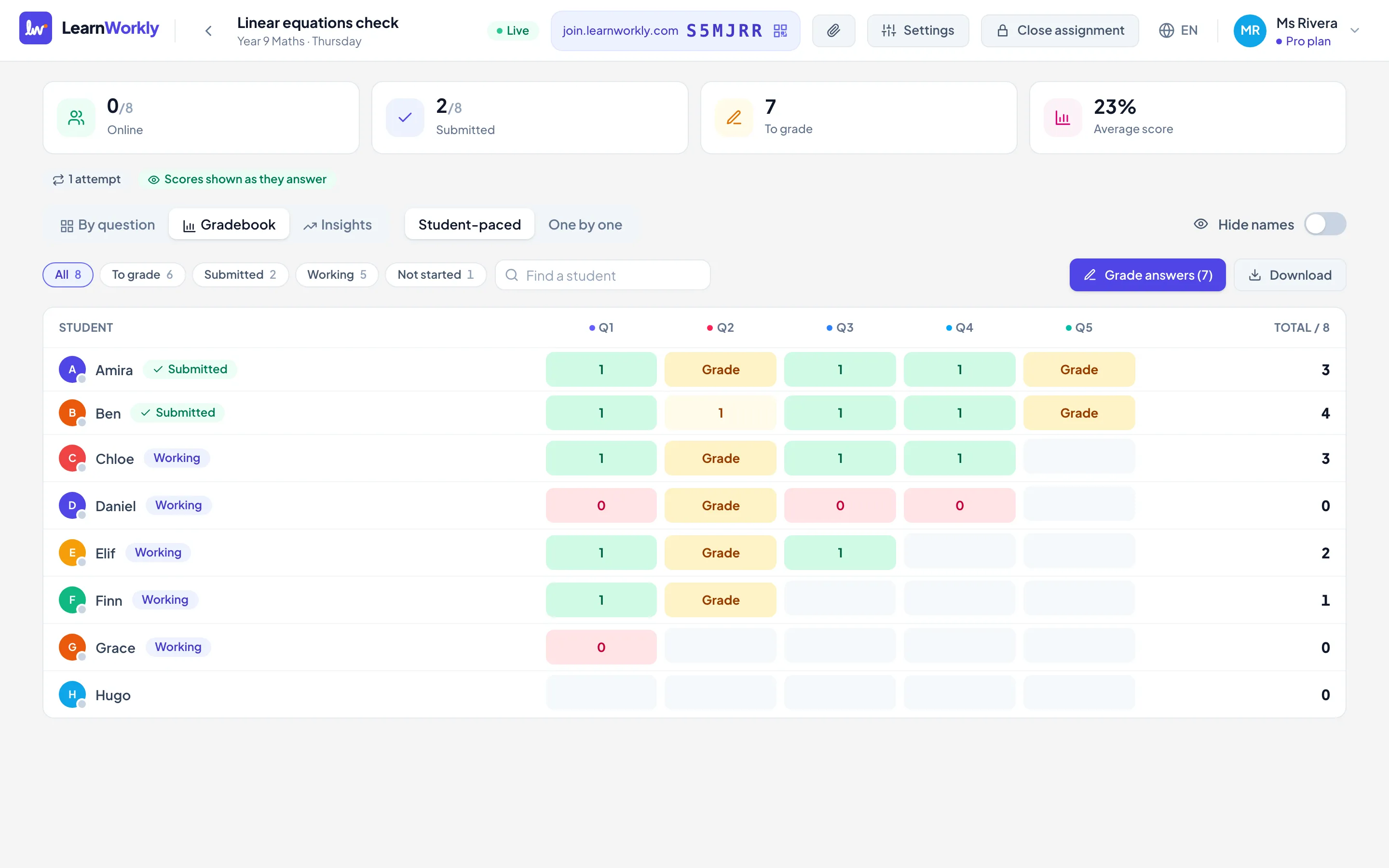
In the gradebook above, Daniel has three red cells and Grace has a wrong first answer. That is who you go to first. The yellow cells are open answers, the ones that need your judgement. Everything with an answer key has already been marked for you, so your marking time goes on the work that needs a teacher.
This also suits strategy 2. A multiple-choice question built on common misconceptions gives you a hinge-question check in seconds. A drawing question shows you a pupil’s working, not only the answer. All 13 question types, including drawing, audio and free response with a rubric, are on every plan, the free one included. When you want to discuss answers with the whole class, turn on Hide names before you put the screen on the board, and the work becomes material for a peer discussion without anyone being put on the spot.
Where to start
Pick one of the five strategies and give it a half term. Strategy 2 is the easiest first step for most teachers, because it needs no marking and changes the next ten minutes of a lesson straight away. Once hinge questions feel routine, add strategy 3 and replace written comments with codes and whole-class feedback. Self- and peer assessment come last, when pupils have seen enough good work to judge it.
Keep it small and keep it going. One question that shows you what the whole class thinks, asked every lesson, does more than a full AfL policy that nobody has time to follow.