What is formative assessment? A guide for tutors
What is formative assessment? A plain-English guide for tutors: what it means, the five key strategies in online lessons, and a simple weekly routine.
LearnWorkly team6 min read
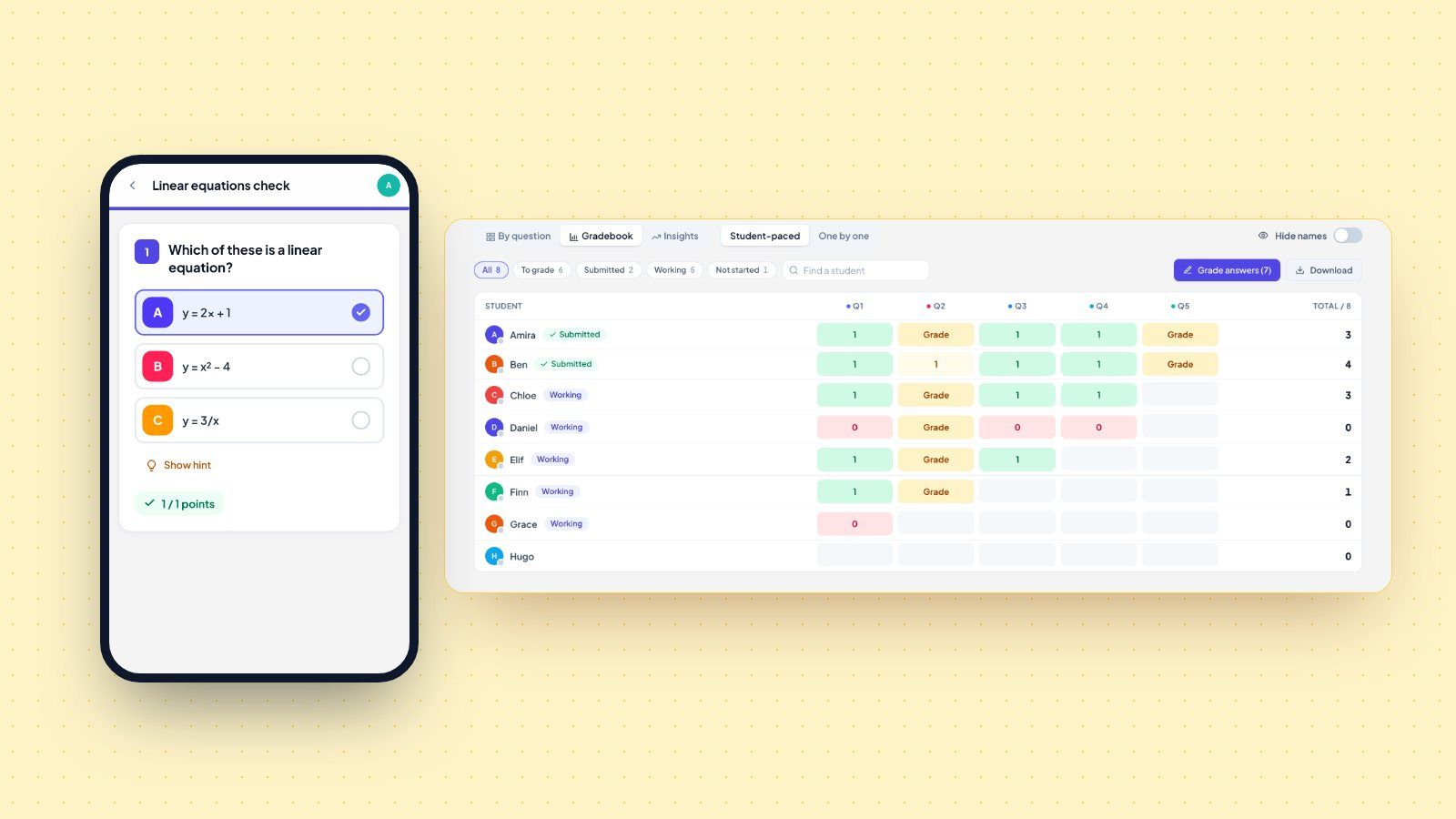
Ask ten tutors what formative assessment is and you will hear “quizzes”, “exit tickets” and “asking questions”. All of those can be part of it, but none of them is the whole idea. So what is formative assessment, really? It is the habit of finding out what a student understands while you are still teaching them, and changing what you do next because of it.
That last part is what makes it formative. A quiz that you mark and file away is just a quiz. The same quiz, used to decide that Tuesday’s lesson starts with fractions again instead of moving on, is formative assessment. This guide explains the meaning in plain English, shows how the research translates to 1-to-1 and small-group online tutoring, and ends with a routine you can run every week.
What is formative assessment? A plain definition
The clearest description comes from Dylan Wiliam, who spent years researching it with Paul Black. In a chapter on formative assessment published by UCL, he describes it as teachers’ “minute-by-minute and day-by-day use of assessment to modify instruction”, also called assessment for learning.
He frames it around three questions that every lesson should answer:
- Where is the learner now?
- Where are they going?
- How do they get there?
The meaning of formative assessment, then, is not a type of test. It is a loop: collect evidence, interpret it, adjust. If the evidence never changes what you or the student does next, it was not formative, however many questions you asked.
Formative vs summative, in one minute
Summative assessment sums up learning at the end: a mock exam, an end-of-unit test, a final grade. Its job is to report. Formative assessment happens during learning, and its job is to steer.
The same question can be either. A past-paper question at the end of term is summative. The same question set halfway through a topic, with you looking at the answers and reteaching the step most students missed, is formative. The difference is what you do with the result, not the question itself.
The five key strategies, translated for online tutoring
Wiliam groups formative assessment in teaching into five key strategies. They were written with school classrooms in mind, but each one maps neatly onto online tutoring.
1. Make the goal and “what good looks like” clear
Students learn faster when they know what they are aiming for. In a tutoring session that can be as simple as saying, at the start: “By the end, you should be able to solve two-step equations and explain each step.” Show one finished example of a good answer, so “explain each step” has a concrete meaning.
For essay or speaking work, share two or three short success criteria (“uses the past simple correctly”, “gives a reason for each opinion”) and come back to them when you give feedback.
2. Ask questions that reveal thinking
Wiliam’s first strategy is to plan questions and tasks that “elicit evidence of student learning”. The key word is plan. Questions made up on the spot tend to be “Does that make sense?”, which tells you nothing.
Good questions have wrong answers that point to a specific misconception, and they get a response from every student, not just the quickest one. In a small group, that means everyone answers on their own screen before anyone speaks. In 1-to-1 lessons, it means asking for the working, not only the final number. For a full toolkit of question types and routines, see our guide to nine techniques for checking understanding in online tutoring.
3. Give feedback that moves learning forward
Feedback is where most of the gains are, and where most of the waste is. Wiliam cites a review of 131 studies that found feedback, on average, improved performance, but in almost two in five studies it made performance worse. The difference was focus: feedback about the person or a comparison with others tended to hurt, while feedback about what to do next helped.
For a tutor, that means fewer “Good job!” comments and more “Look at line 2: what happens to the +5 when it moves across?”. It also means feedback the student can act on straight away, ideally on the work itself.
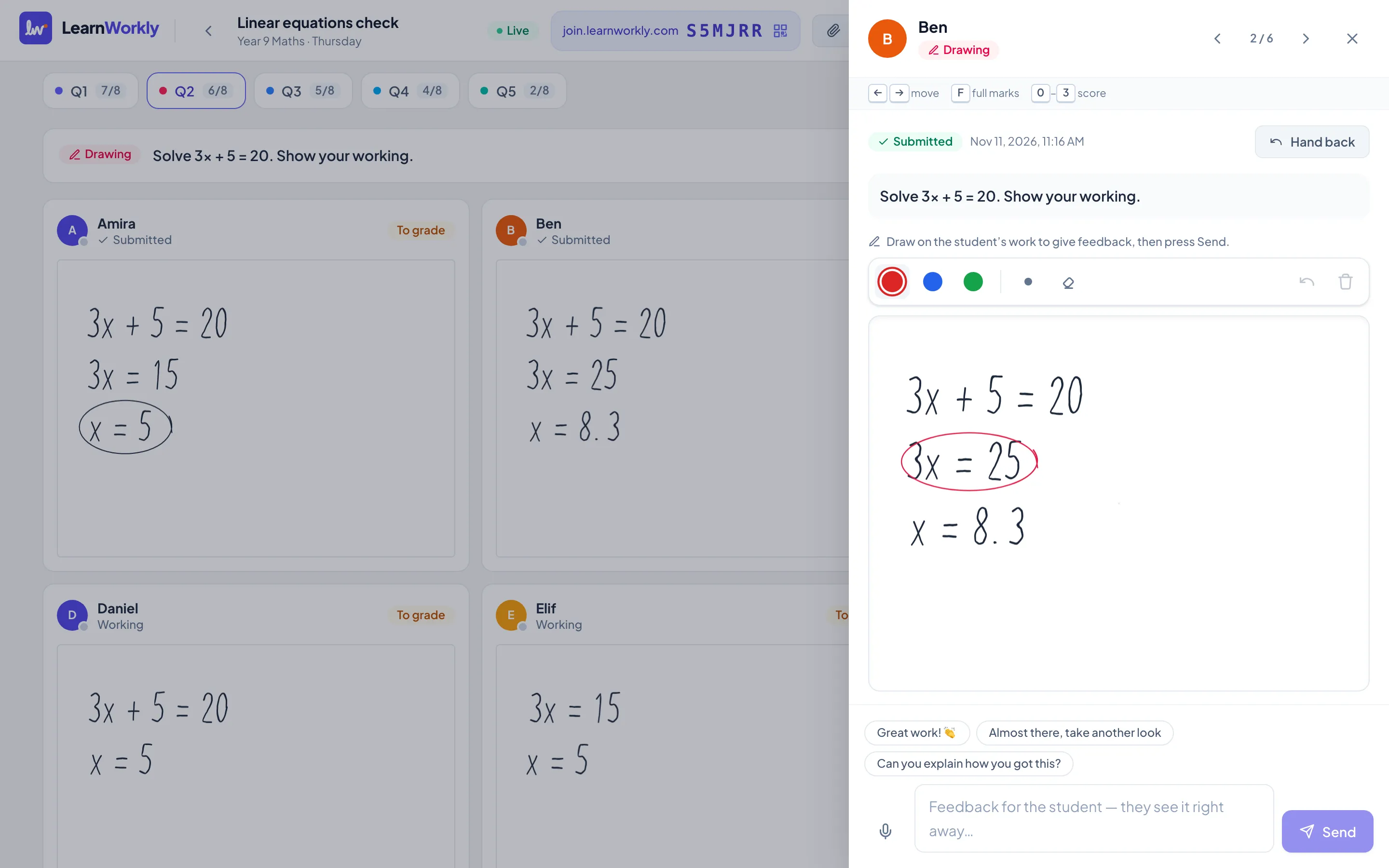
In LearnWorkly you can reply to any answer with a comment, a voice note or a drawing on top of the student’s work, and the student can reply back, so you know whether the fix actually landed.
4. Let students learn from each other
In small groups, students are a resource you can use. Show three anonymous answers to the same question and ask the group which one is best and why. Comparing a correct answer with a nearly correct one often teaches more than your explanation would.
In 1-to-1 lessons there is no group, but you can still borrow the idea: show an anonymous answer from another student (or one you wrote with a deliberate mistake) and ask your student to mark it.
5. Help students own their learning
The final strategy is about students judging their own work. Ask them to check their answer against the success criteria before they submit, or to tell you which question they found hardest and why. Over time, students who can spot their own mistakes need you less, which is the point of tutoring.
What good evidence looks like
Formative assessment is only as good as the evidence it runs on. A few rules of thumb:
- Every student, not a show of hands. In a group of six, one confident answer tells you about one student. You need six answers.
- Working, not just answers. A wrong final answer can come from a slip or from a misconception. Only the working tells you which.
- Written or recorded, not nods. “Yes, I get it” on camera is not evidence. A sentence typed in the student’s own words, or a 30-second recording, is.
- Recent and specific. “She is weak at algebra” is too vague to act on. “She adds instead of subtracting when moving a term across the equals sign” tells you exactly what to teach next.
This is what the live view in LearnWorkly is built for: every student’s answers, drawings and working appear on one screen as they write them, so you see the whole group at once.
Common mistakes
- Collecting evidence and doing nothing with it. If the plan for the next lesson is the same whatever the answers were, the questions were not formative.
- Grading everything. A score at the top of the page draws attention away from the comments. For practice work, comments alone are often better.
- Checking only at the end. An exit ticket is useful, but by then the lesson is over. Put at least one check halfway through, while you can still change course.
- Asking the group and listening to one. The fastest student answers, the others agree, and you move on with a false picture.
- Making it a big event. Formative assessment works best in small, frequent doses that take a minute or two, not a monthly test.
A simple weekly routine
You do not need to redesign your teaching. A light routine covers all five strategies:
- Before each lesson (5 minutes): write the goal in one sentence and one planned question whose wrong answers you can predict.
- In each lesson: ask the planned question halfway through, get an answer from everyone, and decide on the spot whether to move on or reteach.
- After each lesson (10 minutes): reply to open answers with one specific next step per student. Tag questions with the skill they test.
- Once a week (15 minutes): look at each student’s scores by skill. Pick the one skill that most needs revisiting and open next week’s first lesson with three questions on it.
After a month, you have a clear record of what each student can do, built from real work, which also makes conversations with parents much easier.
Getting started
If you have used Formative or a similar tool in a school, the ideas are the same; the difference is scale. School platforms are built for whole classes and districts, while tutors need something that fits a 1-to-1 or small-group lesson. We wrote an honest comparison of LearnWorkly and Formative for tutors if you are weighing the two.
Formative assessment is a habit, not a product. But the right tool makes the habit easier to keep. If you want to try this routine in your next lesson, LearnWorkly is free for up to 10 students.