How to tutor GCSE maths: a 12-week term plan
How to tutor GCSE maths with a 12-week term plan: a diagnostic first lesson, a weekly lesson routine, past-paper method marks and clear updates for parents.
LearnWorkly team7 min read

Most GCSE maths students arrive with the same request: “I need to get my grade up.” What they rarely arrive with is a clear picture of where the marks are being lost. If you are working out how to tutor GCSE maths well, the answer is less about clever explanations and more about a plan: find the gaps, close them in a sensible order, and check every week that the fixes are holding.
This guide sets out a practical 12-week term for 1-to-1 or small-group online tutoring. It is built around one idea: you need to see the working, not just the answer.
Know the exam you are tutoring for
Before you plan anything, be precise about the qualification. Taking AQA as an example, its GCSE Mathematics specification has a Foundation tier (grades 1 to 5) and a Higher tier (grades 4 to 9), and three written papers of 1 hour 30 minutes each. Paper 1 is non-calculator; Papers 2 and 3 allow a calculator. Edexcel and OCR set their own papers, so check your student’s exam board and tier with their school rather than assuming.
Two things follow for your planning. First, non-calculator fluency is not optional, so arithmetic with fractions, negatives and percentages has to be practised without a calculator every week. Second, a student sitting Foundation is aiming at a different ceiling from one sitting Higher, and your topic list should reflect that.
Weeks 1–2: diagnose before you teach
The biggest mistake new GCSE tutors make is starting with whatever topic the student is doing at school this week. Instead, spend the first lesson (and some of the second) finding out what they actually know.
A good diagnostic is short questions across the main areas: number, algebra, ratio and proportion, geometry and measures, probability and statistics. Aim for two or three questions per area, mixed in difficulty, with working required on every one. You are not looking for a score. You are looking for patterns:
- Are errors random slips, or the same misconception again and again?
- Do they set work out clearly, or does everything happen in their head?
- Where do they stop trying?
Online, the working is the hard part to see. Ask students to write on paper, then photograph it with their phone, or draw directly on screen for shorter questions. We wrote a full guide to seeing handwritten maths work online, and it is the foundation of everything below.
By the end of week 2 you should have a ranked list of five to eight weak areas. That list is your term.
Weeks 3–10: sequence topics by weakness
Do not teach the list in textbook order. Order it by two questions: which gaps cost the most marks, and which gaps block other topics?
Some topics are foundations for others. A student who cannot rearrange a simple equation will struggle with simultaneous equations, straight-line graphs and changing the subject of a formula. Fix the blocker first, even if it feels basic. Fraction and negative-number errors leak into almost every paper, so they usually come early too.
A typical sequence for a Foundation student aiming for a secure grade might look like this:
| Weeks | Focus | Why here |
|---|---|---|
| 3–4 | Fractions, negatives, order of operations | Underpins every non-calculator question |
| 5–6 | Solving and rearranging equations | Unlocks graphs and formulae |
| 7–8 | Ratio, proportion and percentages | Common, high-mark, often in context |
| 9–10 | Area, angles and the student’s weakest geometry topic | Picked from the diagnostic |
Treat the table as a template: if the diagnostic says ratio is the real disaster, move it up.
A weekly GCSE maths tutoring plan for each lesson
Every lesson follows the same four parts, so the student knows what to expect and you spend no time deciding what happens next.
Retrieval starter (5–8 minutes)
Three or four quick questions on topics from previous weeks, not this week. Number and short-answer questions mark themselves, so you see straight away who has kept what.
Worked example (10 minutes)
Model one problem from start to finish, saying your thinking out loud: what you notice, what you try first, how you check. Then give a near-identical problem for the student to do straight after, so they copy the structure while it is fresh.
Independent practice with working visible (20–25 minutes)
This is the heart of the lesson. Students solve three or four problems on paper and send a photo of each, or draw the working on screen. In a small group you see every student’s working side by side, so you can spot that two students made the same error and address it once. Circle the line where it goes wrong and ask a question rather than giving the fix. Our handwritten work feature is built for exactly this: a QR code on the question, a photo from the student’s phone, and the page arrives on your screen a few seconds later.
Exit check (5 minutes)
One question on today’s topic, working shown. If they get it right with sound working, the topic moves to the “retrieve later” pile. If not, it comes back next week.
Homework with due dates, not “when you can”
Homework should be short, specific and due on a date. Twenty minutes of practice on this week’s topic plus two retrieval questions on older ones is plenty. Set it as an assignment with a due date so both of you can see what was done, what was late and what was missing. On paid plans, students who have not finished get a reminder email before the deadline, which saves you chasing.
Mark the working on homework as carefully as in the lesson. A correct answer with no working is worth less to you than a wrong answer with clear working, because only the second tells you what to teach.
Past papers and method marks
From around week 8, bring in past-paper questions, and teach students how they are marked. AQA’s published mark schemes, for example, explain that method marks are awarded for a correct method which could lead to a correct answer, and that marks are usually not awarded to students who show no working on questions that ask for it.
That changes how students should behave in the exam. A student who writes down a sensible first step on a hard question can pick up marks even if they never reach the answer. Make this concrete: mark past-paper answers with a simple rubric (one point for a correct method, one for accuracy) so the student sees exactly where marks came from. In LearnWorkly, open questions such as drawings and photos can carry a rubric with several criteria, so a “method” and an “answer” point appear separately in their results.
Weeks 11–12 are for mixed practice: short timed sections from real papers, one non-calculator and one calculator, followed by a careful look at where the method marks were won and lost.
Track progress by skill, not just by score
An overall percentage hides the story. A student can score 60% two weeks running while fixing fractions and slipping on angles. Tag every question with a skill (“Rearranging”, “Fractions”, “Angles in polygons”) and track each one separately.
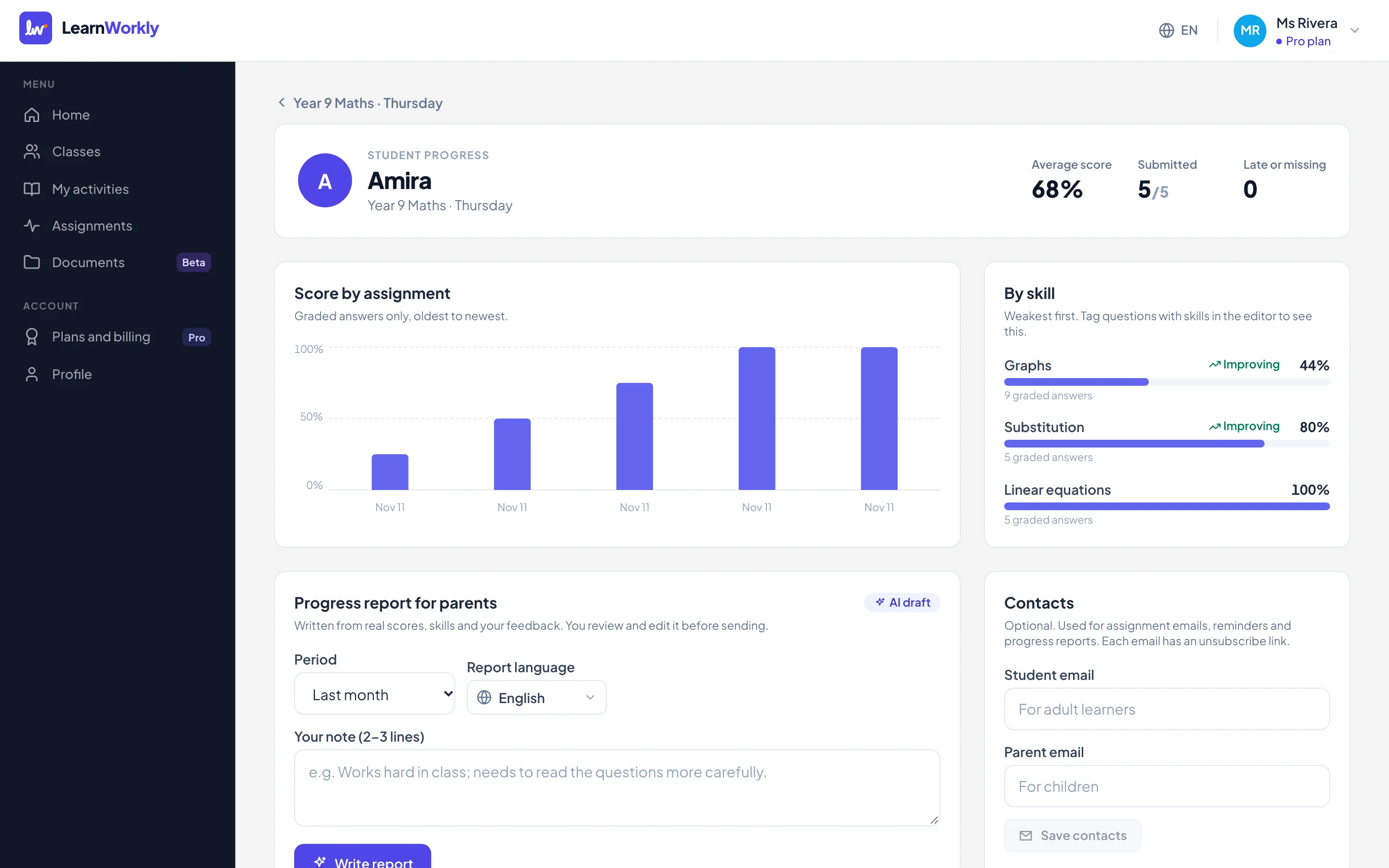
In LearnWorkly each student has a progress page with a score per assignment and a By skill list, sorted weakest first, marked as improving or slipping when recent work differs clearly from earlier work. That list is how you decide what next week’s retrieval starter should contain. You can see how the pieces fit together for maths specifically on our page for online maths tutors.
Telling parents about progress
Parents of GCSE students want to know two things: is it working, and what grade is realistic? Avoid promising a grade. Instead, report on skills: what was weak in the diagnostic, what is now secure, and what comes next. A short update every four weeks, at the end of weeks 4, 8 and 12, fits the plan naturally.
Keep it based on real work, such as scores by skill and a photo of a question they once got wrong and now set out cleanly.
How to tutor GCSE maths: the plan at a glance
If you only keep a few GCSE maths tutor tips from this guide, keep these:
- Weeks 1–2: diagnostic across all areas, working required, ranked list of gaps.
- Weeks 3–10: topics ordered by weakness and by what they unlock.
- Every lesson: retrieval starter, worked example, independent practice with working visible, exit check.
- Every week: short homework with a due date.
- Weeks 8–12: past-paper questions, method marks, mixed timed practice.
- Weeks 4, 8, 12: a skills-based update for parents.
If you tutor GCSE maths online and want to see every line of your students’ working as they write, start free for up to 10 students.