Retrieval practice for tutors: quick quizzes that stick
Retrieval practice for tutors: why recalling beats rereading, how to space it over weeks, and quick low-stakes quizzes to start and end each lesson.
LearnWorkly team5 min read

Every tutor knows this lesson. Last week your student solved simultaneous equations confidently. This week they look at the same kind of question as if they have never seen it before. Nothing went wrong in the lesson. The learning was real, but it was not yet secure.
Retrieval practice is the simplest fix for that problem, and it costs almost nothing to add to your lessons. This guide explains what retrieval practice is, why it works better than rereading or re-explaining, and how to build it into every lesson and every week with short, low-stakes quizzes.
What retrieval practice is
Retrieval practice means asking students to bring information back from memory, instead of looking at it again. A quick quiz, a blank page where a student writes everything they remember about a topic, or a single question about last month’s work all count.
The key word is effort. Reading notes again feels productive, because everything looks familiar. But recognising something is not the same as being able to recall and use it. When a student has to pull an answer out of memory, especially after a gap, that memory becomes stronger and easier to reach next time.
In his widely read summary of research on effective teaching, Principles of Instruction, Barak Rosenshine puts this first: begin a lesson with a short review of previous learning. He also recommends weekly and monthly review, so that older material keeps coming back.
Why rereading and re-explaining are not enough
When a student forgets something, the natural reaction is to explain it again. That helps in the moment, but it puts you in charge of remembering, not the student. Re-explaining every week can hide the real problem: the student understands while you are talking, then cannot do it alone.
Rereading has the same weakness. It gives a feeling of fluency (“I know this”) without testing whether the student can actually produce the answer. Retrieval does the opposite: it can feel harder and slower, which is exactly why it works. A wrong answer in a low-stakes quiz is useful information, not a failure.
Start every lesson with a retrieval starter
The easiest place to begin is the first five minutes of each lesson. A simple pattern that works for most subjects:
- One question from last lesson. Did the main idea stick for a week?
- One question from two to four weeks ago. This is where forgetting shows up.
- One question from earlier in the term or year. Old material that will appear in the exam.
- One “explain” question. “Why does dividing by a negative flip the inequality?” Explaining is harder than answering, and more revealing.
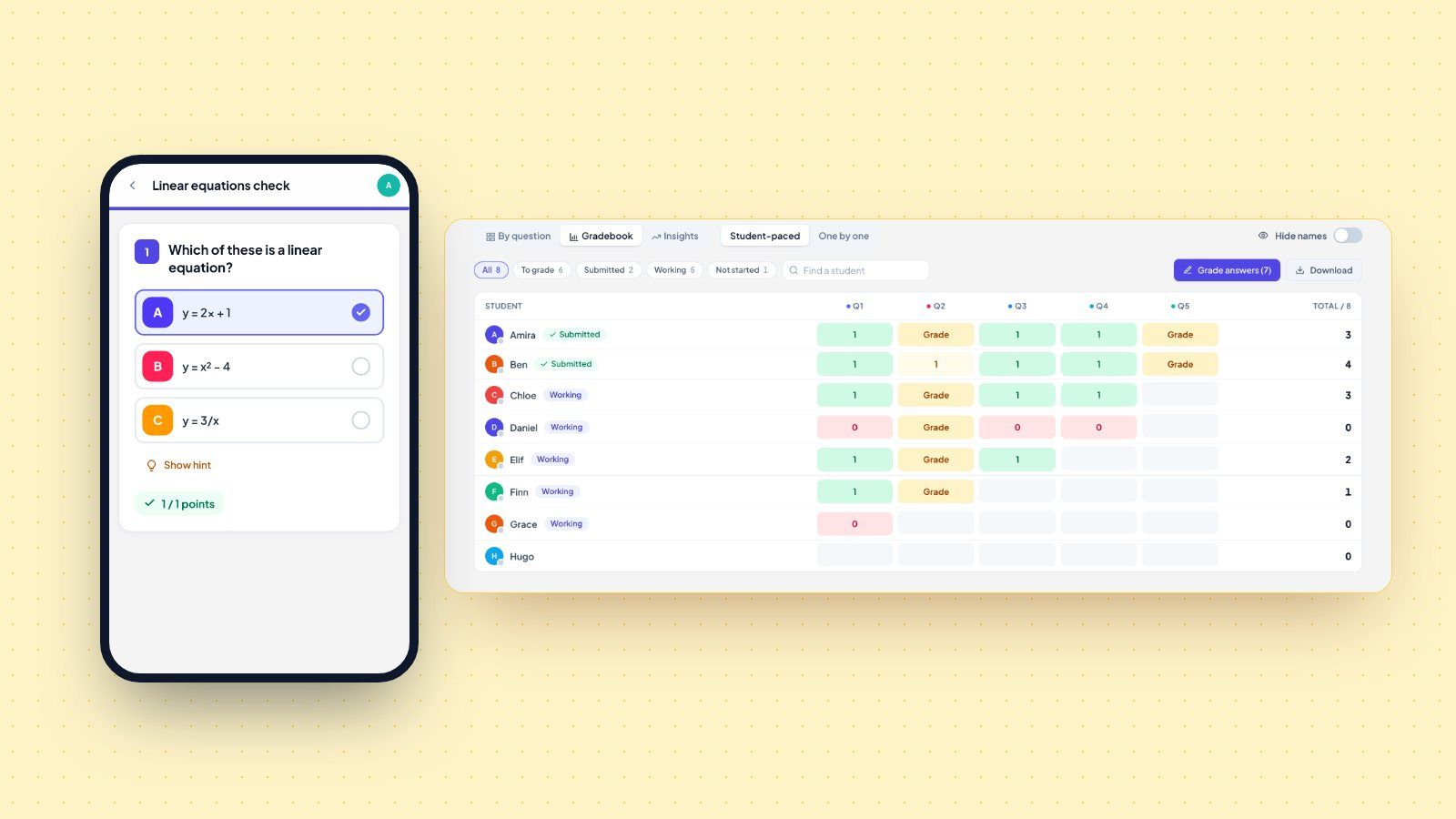
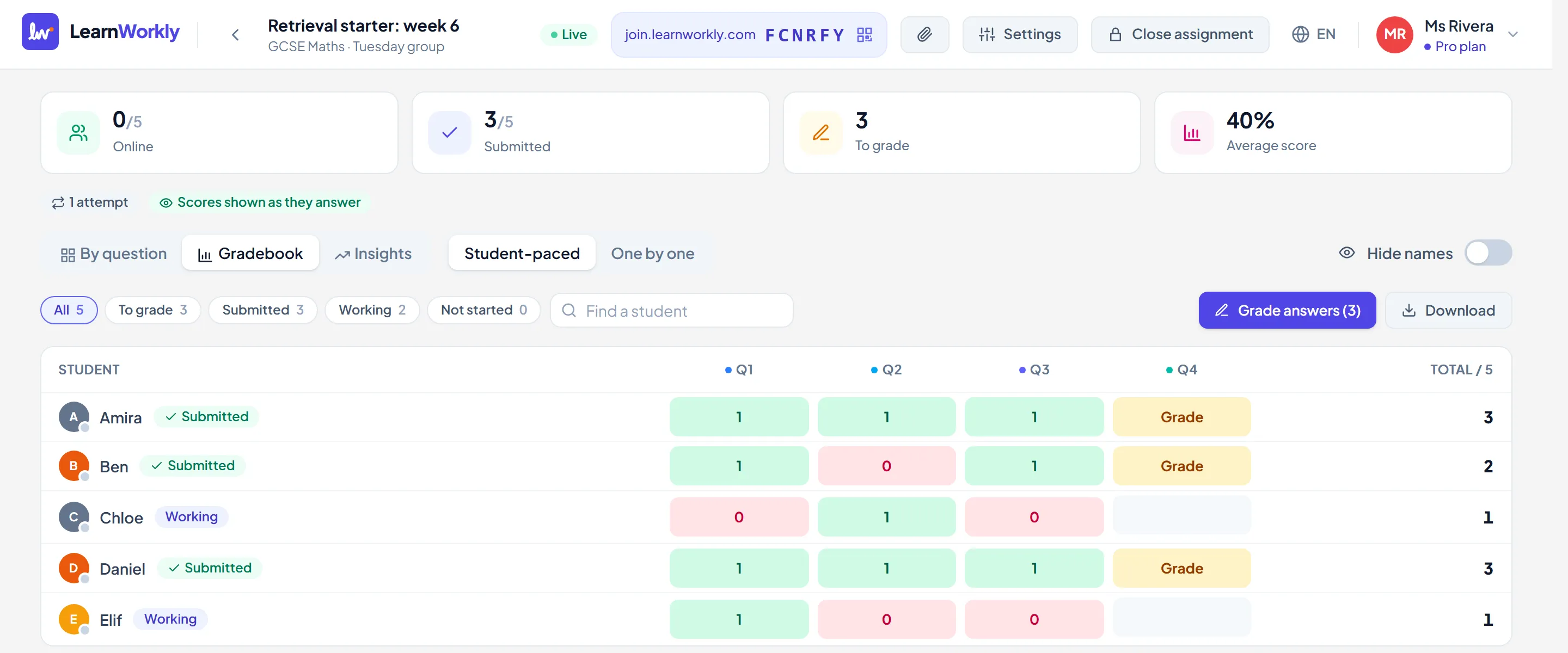
Keep it short: three to five questions, all answered before you discuss anything. In a group, everyone answers on their own screen, so you see every student’s recall, not just the fastest one’s. Look at the answers before you plan the rest of the lesson. If three students forgot the same thing, that is your first five minutes of teaching.
Questions with a single correct answer, such as short answers, numbers and multiple choice, can be marked automatically, so the starter costs you almost no marking time. LearnWorkly has 13 question types, and the ones with an answer key are marked as soon as students answer.
Space practice out over weeks
Retrieval works best when there is a gap between learning something and recalling it. Practising a topic five times in one evening feels efficient but fades quickly. Practising it once a week for five weeks lasts much longer.
For tutors, spacing is easy to plan with a simple rule: every topic comes back at least three times after you first teach it, for example after one week, after three weeks and after six weeks. A few ways to make that happen:
- Keep a running list of topics for each student or group, with the date you taught each one.
- Mix topics in homework. Two questions on this week’s topic and three on older ones, rather than ten on this week’s.
- Build a bank of questions you can reuse. A question that took five minutes to write can come back in ten different lessons.
Low stakes, high frequency
Retrieval practice is not a test. If students think every quiz counts, they get anxious and some will start looking things up. Make it clear that these quizzes are for remembering, not grading:
- Do not record every starter score as a grade. Use the results to plan, not to judge.
- Show the correct answer straight away, so a mistake is corrected before it settles in.
- Praise effort and improvement, not perfect scores. “You remembered three out of four from last month” is real progress.
- Let students retry. For self-study between lessons, unlimited attempts are fine.
In LearnWorkly, you can choose whether students see their scores as they answer or only after they submit. For retrieval starters, showing scores straight away gives students instant feedback while you watch the results come in.
Retrieval between lessons
The time between lessons is where most forgetting happens, so a little retrieval there goes a long way. Two simple options:
- A short weekly quiz with mixed questions from the last few weeks, set as homework with a due date before the next lesson.
- Self-study practice that students can repeat as often as they like. In LearnWorkly, any activity can be assigned as Practice: flashcards and a quiz with instant answers, not graded, open as long as the assignment is open.
Ask students to try recalling first and only then check. Flipping a flashcard before thinking is just rereading with extra steps.
How to tell if it is working
You do not need a spreadsheet to see the effect. Watch for:
- Fewer “I’ve forgotten” moments at the start of lessons.
- Better answers on older topics in starters and homework.
- Students starting to self-test, asking “Can you quiz me on this?” instead of “Can you explain it again?”
Tagging questions by skill makes this clearer over a term: you can see which topics are secure and which keep slipping. For the wider picture of how this fits into checking learning, see our guide to formative assessment for tutors.
Start with your next lesson
Pick three questions: one from last week, one from a month ago, one from the start of the term. Ask them in the first five minutes of your next lesson, before you teach anything new, and look at every answer. That is retrieval practice, and it gets more useful every week you keep it up.
If you want quick quizzes that mark themselves, LearnWorkly is free for up to 10 students, with every question type and Practice included.