Advent calendar quiz: one question a day until the holidays
Run an advent calendar quiz in class or at work: one short question a day from 1 to 24 December, live in two minutes or as a self-marking assignment.
LearnWorkly team5 min read
An advent calendar quiz swaps the chocolate behind each door for a question. Every morning from 1 December, the group gets one short question, answers it in a minute or two, and finds out the answer later that day. As a December countdown activity it costs nothing, it takes less time than taking the register, and by the third day people start asking for it. This post gives you two ways to run one, 24 ready questions, and a few rules that keep it fun for a tutor group, a lecture class or an office team.
Why one question a day works
A daily question is a small dose of retrieval practice. Pulling an answer out of memory, even a trivia answer, strengthens it more than reading it again; Roediger and Karpicke showed this in their study of test-enhanced learning. Spread across 24 days, it also builds a habit. The group arrives expecting to think.
Of all the advent calendar ideas for the classroom, this is the one that can quietly revise the term. Mix this term’s content into the calendar. Day 9 could be a key word from October’s topic, and day 16 a calculation from November. Our post on retrieval practice for tutors has more ideas for questions that revise.
Two ways to run an advent calendar quiz
Live: a two-minute question on the big screen
Build one presentation with 24 quiz slides, one per day, and put the date in each title. Each morning, open it, select the day’s slide and choose Start from current slide next to Present. People join at join.learnworkly.com with the code or the QR code beside the slide, type a nickname and answer on their phone. A Select Answer quiz slide gives a countdown, then shows how the room answered and the right option.
This suits a tutor group, a lecture or a team stand-up. The whole thing takes two minutes: thirty seconds to join, twenty to answer, the rest for the reveal and one line of explanation.
Self-paced: a one-question assignment each day
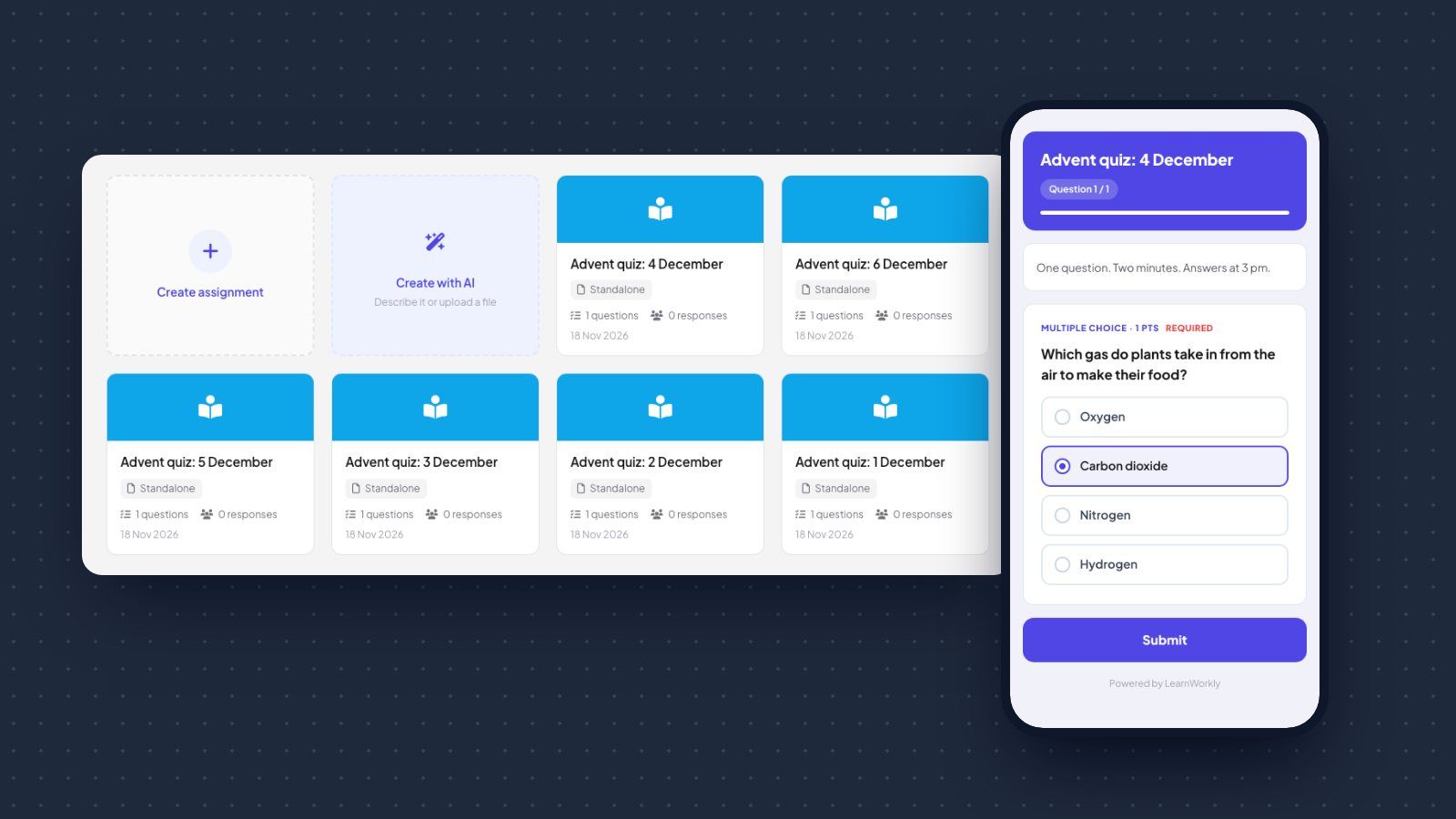
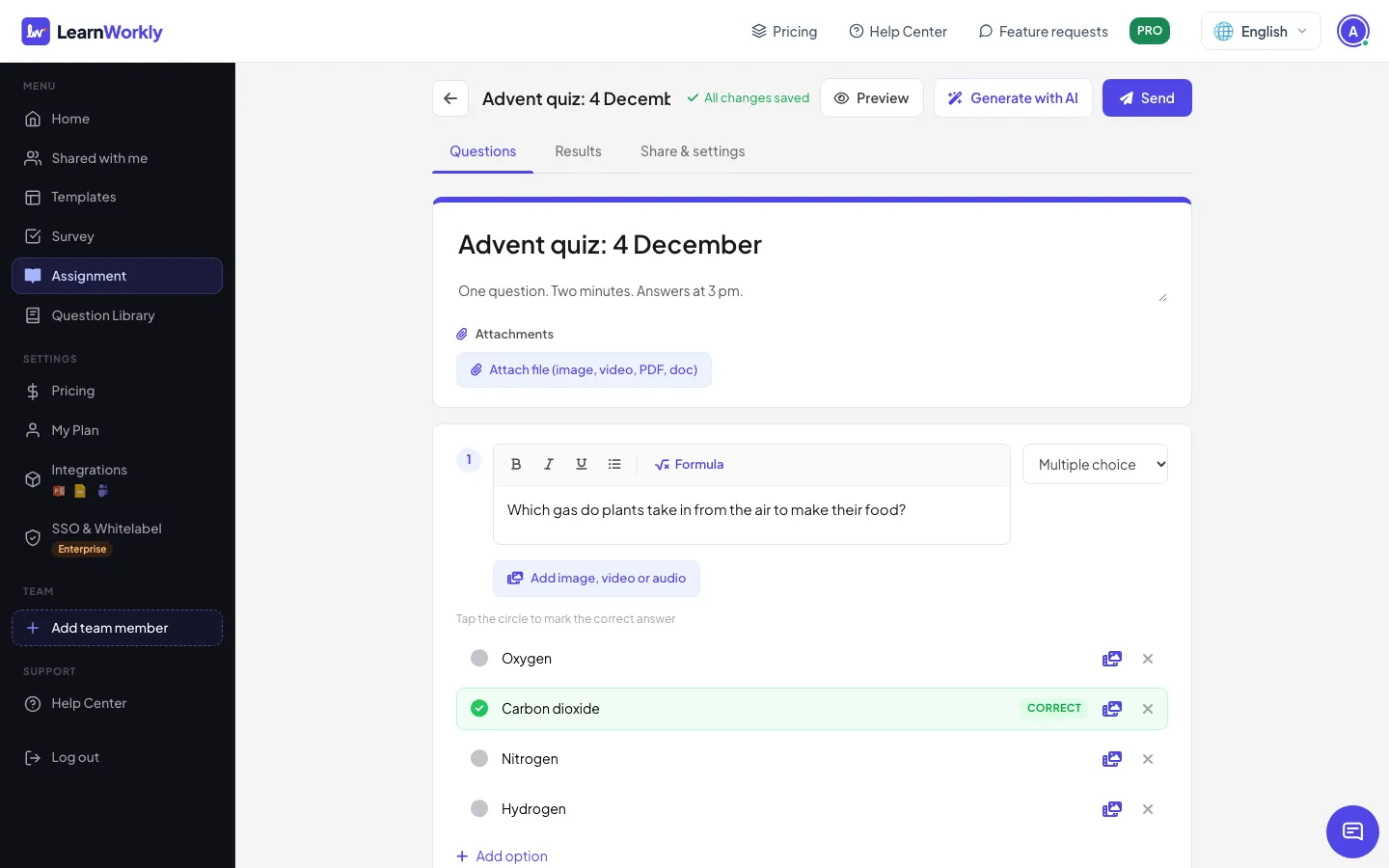
For a group that is never in the same room at the same time, set each day as a tiny self-paced assignment. Create the first one, then use Make a copy on the assignment list for each new day and change the question. People open a link, answer and submit; most question types are marked automatically.
In Share & settings, a few choices make it work as a calendar:
- Due date: 3 pm on the day, so the question closes before people go home.
- Attempts allowed: 1, so the answer reflects what people knew.
- Show answers: After due date, so nobody can pass the answer around before the deadline.
- Explanation / worked solution: one sentence on each question, so the answer teaches something when it appears.
Make all 24 assignments in one sitting at the end of November, then share one link each morning in the class page or team channel. The assignments feature also shows you the results per question, which is a quick way to spot a topic the class has forgotten.
24 advent quiz questions with answers
The questions below suit ages 11 and up and most offices. Swap any of them for your own subject.
Week 1
- 1 December: In which country did the paper advent calendar first become popular? Germany
- 2 December: What is 15% of 200? 30
- 3 December: Which is the longest river in Africa? The Nile
- 4 December: Who painted the Mona Lisa? Leonardo da Vinci
- 5 December: What is the chemical symbol for gold? Au
- 6 December: Today is the feast day of which saint, who inspired Santa Claus? Saint Nicholas
Week 2
- 7 December: How many continents are there? Seven
- 8 December: What is the smallest prime number? 2
- 9 December: Which planet is known as the Red Planet? Mars
- 10 December: Which language has the most native speakers? Mandarin Chinese
- 11 December: At what temperature in Fahrenheit does water freeze? 32 °F
- 12 December: In which city is the Colosseum? Rome
- 13 December: On St Lucia’s Day in Sweden, what does the girl playing Lucia wear on her head? A crown of candles
Week 3
- 14 December: How many sides does an octagon have? Eight
- 15 December: What is the plural of “mouse”? Mice
- 16 December: Which ocean lies between Africa and Australia? The Indian Ocean
- 17 December: Who wrote Romeo and Juliet? William Shakespeare
- 18 December: What is the square root of 144? 12
- 19 December: What do bees collect from flowers to make honey? Nectar
- 20 December: Which country has the largest population? India
The last four days
- 21 December: How many hours are there in three days? 72
- 22 December: Which metal is liquid at room temperature? Mercury
- 23 December: What is a baby kangaroo called? A joey
- 24 December: What do children in many countries hang up on Christmas Eve for presents? A stocking
Rules that keep it fun
One question, every day, same time. The habit matters more than the difficulty. If people know the question appears at 8.45, they look for it.
Keep the stakes low. This is a daily question, not a prize draw. A small treat for the person with the most correct answers on the last day is enough, and nobody should pay to take part. Leave the leaderboard off most days so the people who are slower in the morning still play.
Plan around weekends and the end of term. Schools usually break up before 24 December. Run a “countdown to the last day” with two questions on Mondays, or make the weekend questions an optional extra. At work, the same applies to the days most of the team is on leave.
Include everyone. Not everybody celebrates Christmas, so keep most questions general rather than a daily Christmas question, and call it a December quiz if that fits your group better. A winter theme works just as well; our Christmas quiz for students has a winter round you can borrow for the final week.
Use the answers. If half the class misses the percentage question on day 2, you have a two-minute starter for tomorrow’s maths lesson. At work, a question nobody knew is a good conversation opener at the next stand-up.
Before you start
Write all 24 questions in one go, ideally before the end of November, and check every answer. Facts drift: population rankings and record holders change, so confirm those on the day you write them. Then put a reminder in your calendar for each morning, and let the first door open on 1 December.