True or false questions with answers, and a why round
True or false questions with answers for students, adults and quiz nights, each false one corrected, plus how to write statements that test understanding.
LearnWorkly team· Updated 7 min read

A true or false question takes five seconds to answer, which is both its strength and its weakness. Students can guess right half the time, and a room full of ticks can hide a room full of lucky guesses. Below are 30 true or false questions with answers, grouped for school subjects, for adults at work and for a general knowledge round. Every false statement comes with the correction, because the correction is where the learning happens. After the lists you will find how to write your own statements and how to run them as a live round or a homework check.
Why ask “why?” after true or false
The fix for guessing is old and simple: when the answer is false, ask students to say what would make it true, or why it is wrong. Engineering professors Shaobo Huang and John Mativo used this in a dynamics course, where students judged each statement and had to justify every “false” with a principle or a counterexample before discussing their answers in teams of three or four. The reasons let the authors list the misunderstandings a plain tick would have hidden.
Science teachers do the same thing on paper. In a middle school card sort from the NSTA website, students sort strips of energy and force statements into true and false, and the answer sheet gives every statement in its correct form. Ask students for that rewrite and a coin toss no longer scores.
True or false questions for students
Science
- Sound travels faster in water than in air. True. It moves at roughly 1,480 metres per second in water and about 343 in air.
- Heavier objects always fall faster than lighter ones. False. Without air resistance, all objects fall with the same acceleration. A feather drifts down slowly only because air pushes back on it.
- Most of a tree’s mass comes from the soil. False. Most of it comes from carbon dioxide taken from the air during photosynthesis.
- We have summer because the Earth is closer to the Sun. False. Seasons come from the tilt of the Earth’s axis. The Earth is in fact closest to the Sun in early January, in the northern winter.
- Bats are mammals. True. They have fur, are warm-blooded and feed their young on milk.
Maths
- Multiplying a number always makes it bigger. False. Multiplying by a number between 0 and 1 makes it smaller: 10 × 0.5 = 5.
- 0.5 is greater than 0.45. True. 0.5 is the same as 0.50, and 50 hundredths is more than 45 hundredths.
- Every square is a rectangle. True. A square has four right angles, which is all a rectangle needs.
- 1 is a prime number. False. A prime has exactly two factors, 1 and itself. The number 1 has only one.
- Half of a third is a sixth. True: ½ × ⅓ = ⅙.
History, geography and English
- You can see the Great Wall of China from the Moon with the naked eye. False. It is far too narrow; astronauts say it is hard to spot even from low orbit.
- The Amazon carries more water than any other river. True. It is the largest river in the world by the volume of water it carries.
- Napoleon was unusually short. False. He was about 1.69 m, close to average for a Frenchman of his day. The myth partly comes from old French inches being longer than English ones.
- “Much” is used with countable nouns. False. “Many” goes with countable nouns (many apples), “much” with uncountable ones (much water).
- We say “since 2019” but “for three years”. True. “Since” takes a point in time, “for” a length of time.
True or false questions for adults and work
These suit a training session, a staff meeting warm-up or an onboarding week. For longer workplace sets by topic, see our 50 knowledge check questions for training.
- The padlock and “https” mean a website is safe. False. They mean the connection is encrypted. A scam site can have a padlock too.
- Phishing emails are easy to spot because they are full of spelling mistakes. False. Many are well written. Check the sender’s real address and where links go before you click.
- People in Bcc receive your “Reply all”. False. Bcc addresses are hidden, so a reply all goes only to the sender and the people in To and Cc.
- In Excel and Google Sheets, a formula starts with an equals sign. True. Type = first, then the formula, for example =SUM(A1:A10).
- “Cc” stands for carbon copy. True. The name comes from the carbon paper once used to make copies of letters.
True or false general knowledge
These true or false quiz questions suit a quiz night, a fun Friday or the last ten minutes of term. Most false ones are popular myths, so people will argue, which is the point.
- Lightning never strikes the same place twice. False. Tall buildings are hit again and again; the Empire State Building is struck many times a year.
- Bananas are berries. True, botanically speaking. Strawberries, oddly, are not.
- Mount Everest is the tallest mountain from base to peak. False. Everest is the highest above sea level, but Mauna Kea in Hawaii, measured from its base on the ocean floor, is taller.
- An octopus has three hearts. True. Two pump blood through the gills, one through the rest of the body.
- Goldfish have a three-second memory. False. Studies have trained goldfish to remember tasks for months.
- Humans use only 10% of their brains. False. Brain scans show activity across almost every area, even during sleep.
- Venus is the hottest planet in the solar system. True. Mercury is closer to the Sun, but Venus’s thick carbon dioxide atmosphere traps heat.
- The Pacific is the largest ocean. True. It is bigger than all the land on Earth put together.
- Australia is wider than the Moon. True. The Moon is about 3,474 km across; Australia measures around 4,000 km from east to west.
- Glass is a slow-flowing liquid, which is why old windows are thicker at the bottom. False. Glass is an amorphous solid. Old panes were uneven when made, and glaziers often fitted the thick edge at the bottom.
How to write true or false questions that test understanding
Your best statements will come from the mistakes your own students make. A few rules keep them fair.
- Build false statements from real misconceptions. “Heavier things fall faster” is wrong in a way many people believe, so it tells you something. A random wrong date tells you very little.
- One idea per statement. If half the sentence is true and half is false, students who know the material can still get it wrong.
- Avoid negatives, and never use two. “It is not untrue that…” tests reading, not science.
- Watch the absolute words. Testwise students know that “always” and “never” usually mean false. Use them only when they are the point, as in statement 6.
- Mix the answers. Aim for roughly as many true as false, in no pattern.
- Add the why. Follow a statement with “If false, correct it” or “How do you know?” A one-line reason separates knowing from guessing.
Running a true or false round in class or for homework
In LearnWorkly, a True or False slide shows one statement on the big screen and two large buttons on every phone. You type the statement as the slide title, choose whether it is true or false, and write the reason in the Why? box; that reason is stamped on screen at the reveal, with an optional source. You can also relabel the buttons as Fact / Myth, Real / Fake or Yes / No. The True or False help article shows each step.
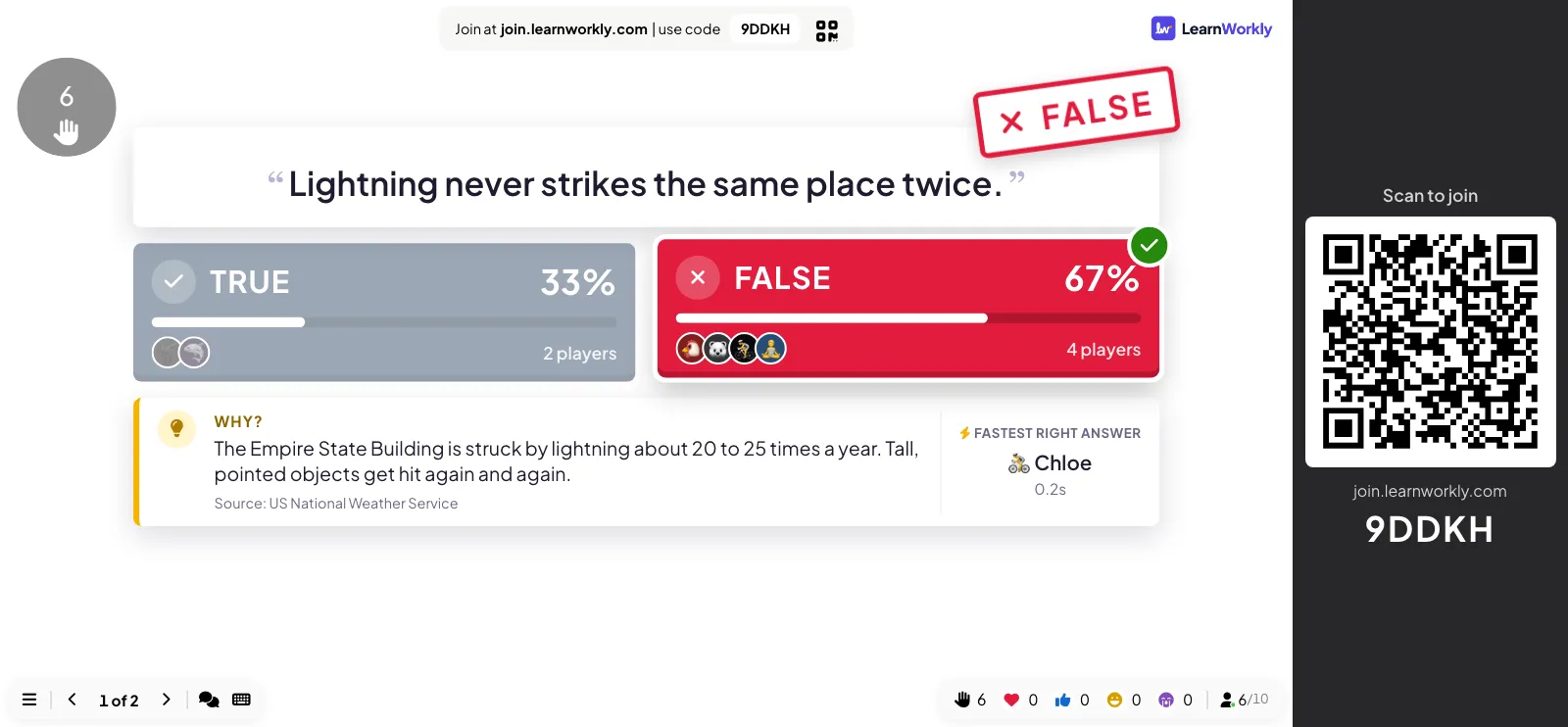
As a live round. Students join on their phones with the code or QR code, everyone answers against a countdown, and the reveal shows how many chose each side next to the reason why. That split is the moment to ask two students to explain their choice before moving on. Fast right answers earn more points for the leaderboard. The live quiz games page shows how a round looks on the big screen.
For the “why” in students’ own words, put an Open Ended slide straight after it: “If you said true, rewrite the statement so it is false.” The answers appear on your screen as they arrive, and a handful shows the misconceptions in the room.
As a homework check. Put the same statements in an Assignment: a link students open at home, with a True / False question type, a due date and automatic marking. The results tab shows each student’s score and each question, so if one statement is mostly wrong, that is where the next lesson starts.
One limit to know: a statement can only be true or false. For “Not given”, as in reading exams, use a Select Answer question with three options: True, False and Not given.