Christmas music quiz with sound: intro rounds that work
Run a Christmas music quiz with real sound: intro clips on the big screen, typed answers on phones, five rounds of questions with answers, and music rights.
LearnWorkly team6 min read
A Christmas music quiz lives or dies on the intro round. Three seconds of sleigh bells, and half the room is shouting a title before the clip has finished. Getting the sound to work is the hard part: a laptop speaker nobody can hear, a clip that won’t start, someone at the back who swears they said it first. This guide covers how to play a clip during each question with LearnWorkly, five rounds of Christmas music quiz questions with answers, and the one thing many quiz hosts forget: whether they are allowed to play the music at all.
How a Christmas music quiz with sound works
Each question is a quiz slide on the big screen. Players join at join.learnworkly.com with the code or QR code and answer on their phones, so there is no shouting and no arguing about who was first: the app records the answers and gives more points for faster right answers.
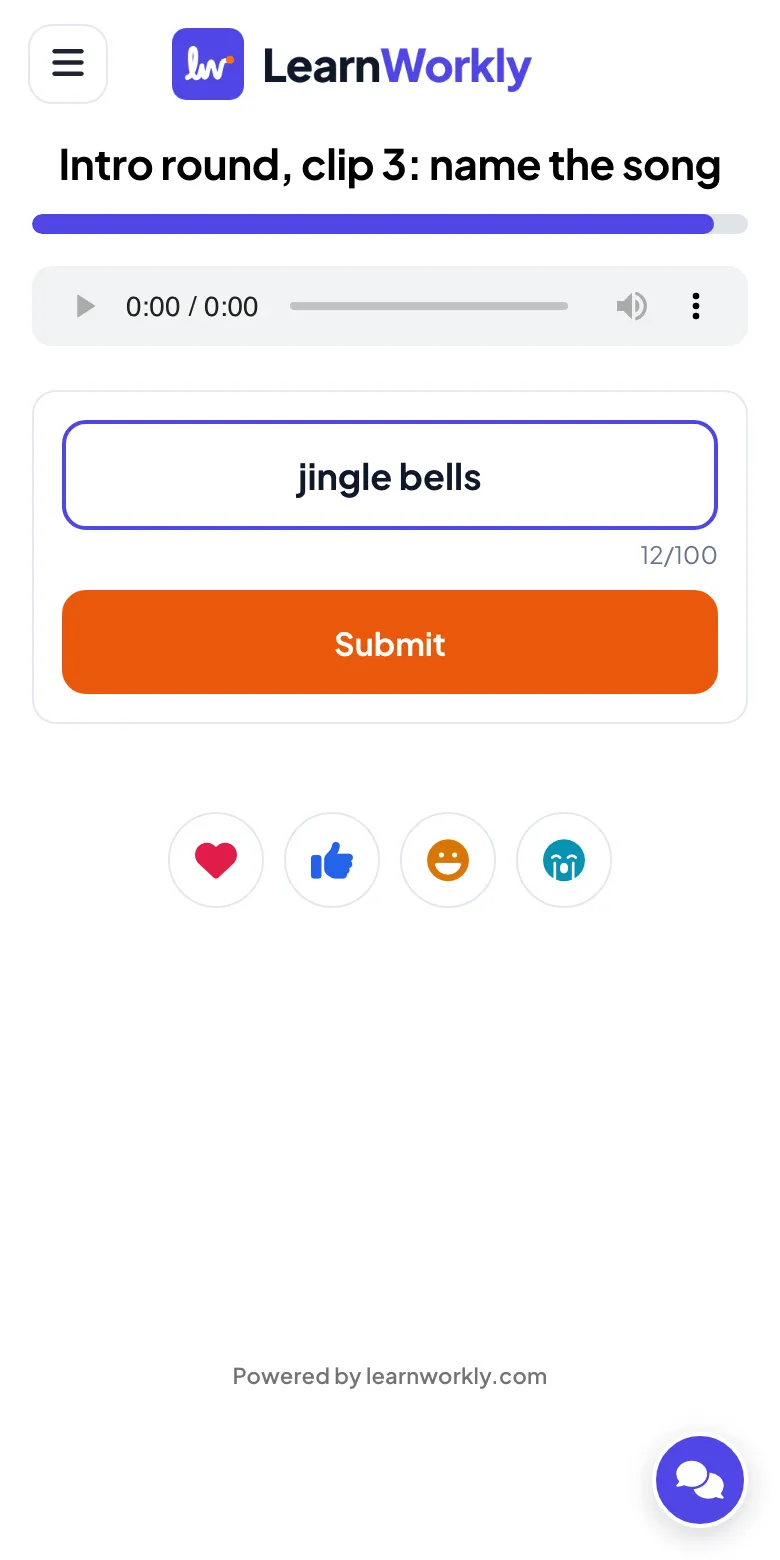
To add a clip, open a quiz slide, go to Settings on the Content tab and use Quiz Audio (Optional) to upload an audio file. During the question countdown, the clip plays on the big screen instead of the game music, and loops until time is up. Phones show a small player with the same clip, which helps remote players and anyone sitting far from the speaker. The slide audio help page explains every sound setting, including Lobby Music and Playing Music for the moments between questions.
Two question types suit a music quiz:
- Type Answer for “name that song”. Players type the title, and you list every answer you accept: “Jingle Bells”, “Jingle Bell”, “One Horse Open Sleigh”. After the question you can accept more answers from the results, which saves arguments over a near miss. See the Type Answer guide.
- Select Answer for facts about songs and composers. Four options, one right, faster than typing.
Clips you are allowed to play
Playing a recording in public is not the same as playing it at home. In the UK, a business playing recorded music to staff usually needs a licence, as PRS for Music explains for music at work. Other countries have their own rules, and a venue may already hold a licence. Check before the night, not during it.
The easiest way round it for an intro round:
- Traditional carols. The music of “Silent Night” (1818), “Jingle Bells” (1857) and “Deck the Halls” is long out of copyright. A recording someone else made is still protected, but a recording you make yourself is yours.
- Record your own clips. Ask a colleague or a pupil who plays the piano, recorder or guitar to play the first five seconds of ten carols, and record them on a phone. It is often the funniest part of the night.
- Hum it. A hummed intro, recorded in the staff room, is surprisingly hard and needs no licence for the recording.
- Royalty-free libraries. Some libraries offer festive recordings with a licence for events. Read the licence for the use you have in mind.
Keep each clip to five to ten seconds. It loops while the timer runs, so a short clip is enough.
Christmas music quiz questions with answers
Five rounds of five questions takes about 35 minutes with scores. Round 1 needs your own clips; the other rounds work without sound.
Round 1: Intro round (name the carol)
Play the first bars of each carol you recorded. Suggested carols, all traditional:
- “Jingle Bells”
- “Deck the Halls”
- “Silent Night”
- “We Wish You a Merry Christmas”
- “O Come, All Ye Faithful”
Give 20 to 25 seconds per question: typing takes longer than tapping.
Round 2: Finish the line (traditional carols)
- “Deck the halls with boughs of …” Holly
- “Good King Wenceslas looked out, on the Feast of …” Stephen
- “Oh bring us some …” (in “We Wish You a Merry Christmas”) Figgy pudding
- “On the fifth day of Christmas, my true love sent to me: five …” Gold rings
- “Hark! The herald angels …” Sing
Round 3: Carols and composers
- Who wrote the music for “Silent Night”? Franz Xaver Gruber
- “Hark! The Herald Angels Sing” is set to a melody by which composer? Felix Mendelssohn
- “Carol of the Bells” is based on a Ukrainian song by which composer? Mykola Leontovych
- Which poet wrote the words of “In the Bleak Midwinter”? Christina Rossetti
- “O Come, All Ye Faithful” is also sung under which Latin title? Adeste Fideles
Round 4: Christmas songs and films
- Which Irving Berlin song did Bing Crosby sing in the 1942 film “Holiday Inn”? “White Christmas”
- Which singer first had a hit with “Rudolph the Red-Nosed Reindeer”, in 1949? Gene Autry
- Who wrote and recorded “Feliz Navidad” in 1970? José Feliciano
- Who recorded “Jingle Bell Rock” in 1957? Bobby Helms
- “Dance of the Sugar Plum Fairy” comes from which ballet? The Nutcracker
Round 5: Music beyond the carols
- Which instrument plays the famous tune in “Dance of the Sugar Plum Fairy”? The celesta
- In which city was Handel’s “Messiah” first performed, in 1742? Dublin
- “Jingle Bells” was first published in 1857 under which title? “One Horse Open Sleigh”
- “Deck the Halls” uses a melody from which country? Wales
- Which French composer wrote the music for “O Holy Night”? Adolphe Adam
For a quiz with office favourites and Christmas number ones, the Christmas quiz for work has a separate round of chart questions, so you can use both without repeats.
Run the music quiz on the night
- Test the sound in the room. Plug the laptop into the room speakers and play a clip from the back of the room before anyone arrives. Phones often block sound until the person taps the screen, so the big screen is your main speaker.
- Keep audio effects on. Your clips play through the same switch as the game sounds, so leave Enable audio effects on in the presentation settings. If the game music between questions gets too much by round five, set Lobby Music to None on the Select Answer slides instead.
- Play in teams. A music quiz is more fun when a table argues about the answer before one person types it. Team mode puts players into teams when they join and ranks the teams on the leaderboard.
- Add a leaderboard after each round. It gives people a breather and makes the last round matter.
- Read the answers aloud. After a typed question, read the accepted answers and accept any fair spelling from the results.
A music quiz for the classroom
In a lesson, a music quiz is a good last-week activity that still teaches. A music teacher can use the composers round as revision, and ask pupils to record the intro clips in the lesson before: playing five seconds of a carol for the class is a small performance with a real audience. In other subjects, keep it to ten minutes at the end of a lesson, with a round of song lyrics translated into the language being studied, or carols counted in a maths question.
Not everyone celebrates Christmas. A winter music round with songs about snow and cold weather, or music from other winter festivals, lets everyone play along.