IELTS Speaking practice online: a 6-week plan for tutors
IELTS Speaking practice online for tutors: how the test works, a six-week plan, recorded Part 2 practice and feedback against the four official criteria.
LearnWorkly team5 min read

A student writes to you: their IELTS test is in six weeks, they need a better Speaking score, and they freeze every time they have to talk for two minutes. Speaking is the part of IELTS that students find hardest to practise alone, which is exactly why they look for a tutor.
This guide is a practical plan for IELTS Speaking practice online: what the test looks like, how to find out where a student is, a six-week plan, how to use recorded answers so students speak far more than they could in lessons alone, and how to give feedback that matches the way the test is marked.
How the IELTS Speaking test works
Start by making sure you and your student know the format exactly. According to the official IELTS Speaking format, the test lasts 11 to 14 minutes, is recorded, and has three parts:
- Part 1: introduction and interview (4–5 minutes). General questions about familiar topics such as home, work, studies and interests.
- Part 2: long turn (3–4 minutes). The candidate gets a task card, has one minute to prepare with pencil and paper, then speaks for up to two minutes. The examiner may ask one or two follow-up questions.
- Part 3: discussion (4–5 minutes). More abstract questions linked to the Part 2 topic, asking the candidate to explain, compare and give opinions.
The examiner marks the whole test against four criteria: fluency and coherence, lexical resource, grammatical range and accuracy, and pronunciation. Everything in your plan should connect back to these four.
Start with a diagnostic, not a lesson
In the first session, run a short mock test under real conditions: a few Part 1 questions, one Part 2 card with exactly one minute to prepare, and a short Part 3 discussion. Record it. Then listen back after the lesson and make notes against the four criteria.
You are looking for patterns, not every slip:
- Fluency and coherence. Long pauses, answers that stop after one sentence, or ideas that do not connect.
- Lexical resource. The same few words repeated, or difficulty talking about less familiar topics.
- Grammar. Mostly simple sentences, or errors with the same structure again and again.
- Pronunciation. Sounds, word stress or intonation that make the student hard to follow.
Share what you found with the student in plain words and agree on two priorities. Six weeks is not long; trying to fix everything means fixing nothing.
A six-week IELTS Speaking plan
With one or two lessons a week, a plan like this works well:
- Week 1: diagnostic and Part 1. Mock test, then short, natural Part 1 answers: answer, add a reason or example, stop.
- Week 2: Part 2 structure. How to use the one minute of preparation, and a simple shape for two minutes: set the scene, describe, explain why it matters.
- Week 3: Part 3 thinking. Giving opinions, comparing past and present, talking about society in general rather than personal experience.
- Week 4: vocabulary by topic. Common topic areas such as work, technology, environment, education and travel, with phrases the student can actually use.
- Week 5: the two priorities. Focused work on the weaknesses from the diagnostic, with targeted recordings.
- Week 6: full mock tests and confidence. Two full mock tests under timed conditions, with feedback on progress since week 1.
Each lesson should end with speaking homework for the days in between. That is where most of the practice happens.
Use recorded answers to multiply practice time
In a 60-minute lesson, a student might speak for 20 minutes at most. Between lessons, they can speak every day if the task is short and clear. Recorded answers make this possible:
- One Part 2 card a day. One minute of preparation, then two minutes of speaking, recorded.
- Three Part 1 questions on a new topic, answered in 20 to 30 seconds each.
- Re-recording after feedback. The same Part 2 card again, using the improvements you suggested.
Recordings have another advantage: students can listen to themselves. Many are surprised by how often they pause or repeat the same word, and noticing it is the first step to changing it.
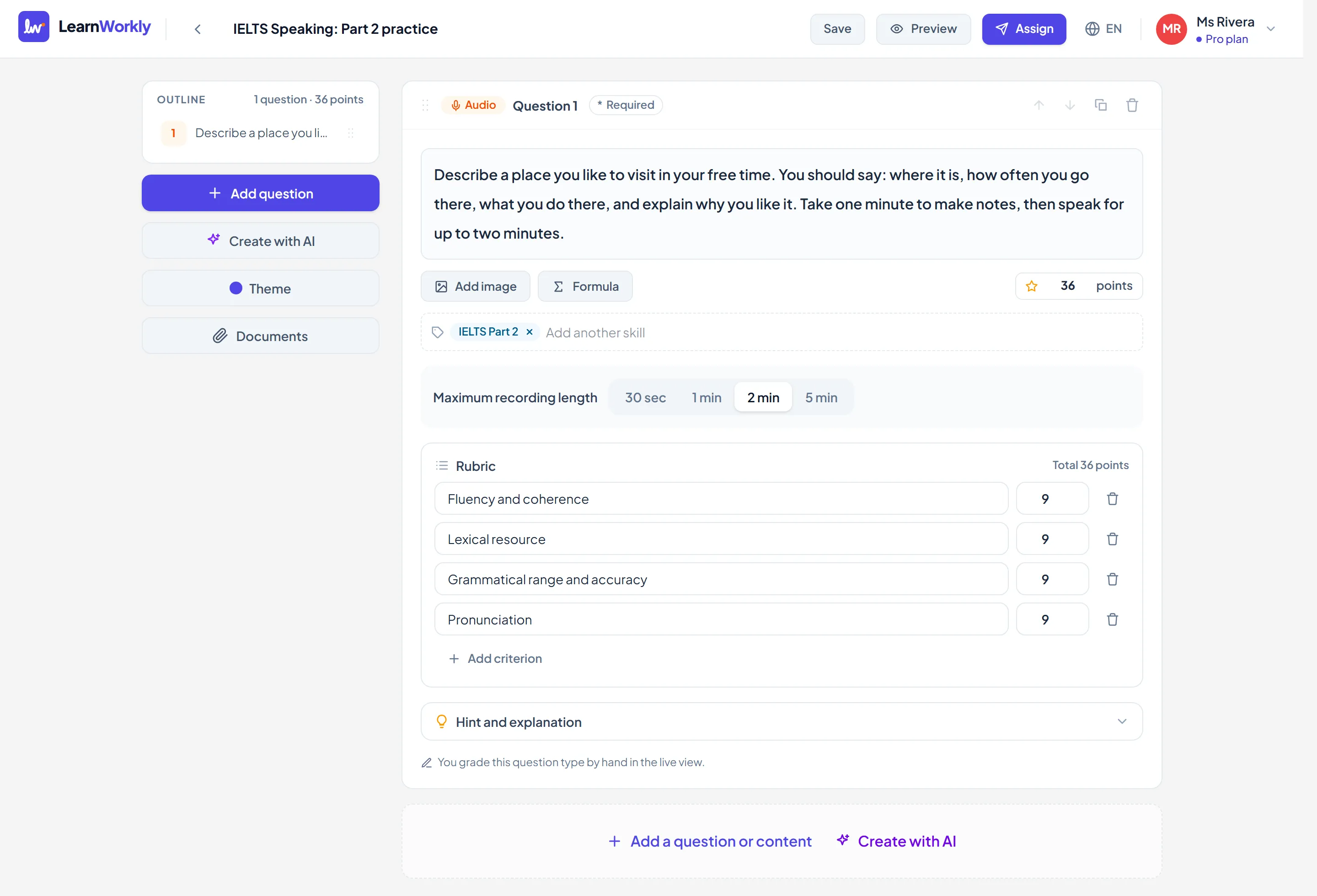
In LearnWorkly, an audio question lets students record in the browser or on their phone, with a maximum length you choose: 30 seconds, 1, 2 or 5 minutes. A two-minute limit fits a Part 2 long turn exactly. You can also add a rubric to the question, so you grade against criteria rather than giving a single score.
Give feedback against the four criteria
Generic comments such as “good fluency” do not help a student improve. Feedback should name a criterion, point to a moment in the recording and give a specific change:
- Fluency and coherence: “At 0:40 you stopped for five seconds. When you need time, use a phrase like ‘That’s an interesting question…’ instead of silence.”
- Lexical resource: “You said ‘good’ six times. Try ‘rewarding’, ‘useful’ or ‘enjoyable’ depending on the meaning.”
- Grammar: “Your Part 2 was all in the present. Use past tenses when you describe something that happened.”
- Pronunciation: “Listen to how I stress ‘phoTOgraphy’ and ‘PHOtograph’, then record both.”
A short voice note is often the best format here, because you can model the language you want. Keep the rubric the same every week so progress on each criterion is easy to see. Avoid promising a specific band score: only the official test gives one, and an honest “your fluency has clearly improved since week 1” is more useful.
Practise with groups as well as one-to-one
IELTS preparation also works well in small groups. Students answer the same Part 2 card at the same time, each recording their own answer, so everyone gets two full minutes of speaking instead of waiting for a turn. Then play one or two answers (with permission) and discuss what made them effective. For more on teaching English online in general, see our guide on how to teach ESL online.
The week before the test
Keep the last week calm and practical:
- One or two full mock tests, timed and recorded, then rest.
- Review the target list and the best recordings from the past weeks, so the student hears how much they have improved.
- Practise the opening minutes. A confident start to Part 1 settles nerves for the rest of the test.
Getting started
For your next IELTS student, record a mock test in the first lesson, pick two priorities, and set one recorded Part 2 card a day. The page on teaching ESL with LearnWorkly shows how audio questions, rubrics and voice-note feedback fit together, and LearnWorkly is free for up to 10 students, with every question type included.