Tutoring progress report template (free, with examples)
A free tutoring progress report template you can copy, plus three filled-in examples: GCSE maths, an adult IELTS learner and a primary pupil.
LearnWorkly team5 min read

Parents rarely ask for a long report. They want to know three things: is my child improving, what is still hard, and is the tutoring worth it. A good tutoring progress report template answers all three on one page, in a few minutes, every time.
Below is a free template you can copy into an email or a document, followed by three filled-in examples for very different students: a GCSE maths student, an adult preparing for IELTS and a primary pupil working on reading and times tables. If you want help with the wording itself, our guide on how to write progress reports parents actually read covers phrasing for strong, steady and struggling students.
How often to send a progress report
For most private tutoring, once a month works well for weekly lessons, and once a term for occasional or exam-season lessons. Monthly is often enough to show change, and rare enough that each report says something new.
Schools work on a longer cycle. In England, for example, the government’s guidance on school reports on pupil performance requires a written report at least once a year, covering general progress, strengths and areas to develop, and how to arrange a conversation with a teacher. Your report can fill the gaps between those, and mirroring the same headings makes it easy for parents to compare.
The template
Copy this and replace everything in square brackets. Keep the whole report under one page.
Progress report: [Student name], [subject] Period: [start date] to [end date] · Lessons: [number attended] of [number planned]
In one line: [One sentence on overall progress, e.g. “A strong month: algebra is now secure.”]
What has improved
- Skill or topic: [evidence, e.g. score went from 4/10 to 8/10 on the same type of question]
What we are working on next
- Skill or topic: [why it matters, e.g. it appears in every Paper 2]
- Skill or topic: [what we will do]
Homework: [number completed] of [number set] · [one sentence on effort or habits]
How you can help at home: [one specific, small action]
Next check-in: [date or “at the end of next month”]
[Your name] · [how to reply or book a call]
Three rules make the template work:
- Every improvement has evidence. A score, a before-and-after, a type of question the student can now do alone.
- At most two “next” points. More than that and parents cannot tell what matters.
- One action at home. Specific and small: “ten minutes of times tables on Tuesday and Thursday” beats “more practice”.
Example 1: GCSE maths, Year 11, monthly
Progress report: Amira, GCSE Maths (Higher) Period: 1 to 31 October · Lessons: 4 of 4
In one line: A strong month: solving equations is now secure, and her last practice paper rose from grade 5 to a borderline 6.
What has improved
- Linear and simultaneous equations: 9/10 on this month’s mixed quiz, up from 5/10 in September.
- Showing working: she now writes every step, which earned method marks on two questions she got wrong.
What we are working on next
- Graph transformations: a common Paper 2 topic she has not met at school yet.
- Exam timing: she spent 20 minutes on the first five questions of the last paper.
Homework: 4 of 4 completed · Always on time, usually the evening before the lesson.
How you can help at home: Ask her to explain one homework question to you each week. Explaining is the fastest test of understanding.
Next check-in: End of November, after her mock exam.
Example 2: adult IELTS learner, termly
Progress report: Kenji, IELTS Academic preparation Period: September to November · Lessons: 11 of 12
In one line: Speaking has moved from about band 5.5 to a solid 6 in practice tests; writing Task 2 is now the priority.
What has improved
- Speaking fluency: recorded Part 2 answers now last the full two minutes, with fewer long pauses.
- Vocabulary for opinions: uses linking phrases correctly in most answers.
What we are working on next
- Writing Task 2 structure: paragraphs often mix two ideas, which lowers the coherence score.
- Articles (a/the): the most frequent error in his writing.
Homework: 9 of 12 completed · Speaking recordings always done; written tasks sometimes skipped.
How you can help yourself: One timed Task 2 essay every weekend, under exam conditions.
Next check-in: Two weeks before the test date.
For adult learners, the “parent” is the learner, so the report speaks to them directly.
Example 3: primary, Year 4, monthly
Progress report: Leo, reading and maths Period: October · Lessons: 3 of 4 (one missed for half term)
In one line: Leo is more confident reading aloud, and his 3 and 4 times tables are now quick and accurate.
What has improved
- Times tables: 3s and 4s answered in under five seconds each, up from guessing in September.
- Reading: reads a full page aloud and can answer “why” questions about what happened.
What we are working on next
- 6, 7 and 8 times tables, ahead of the Year 4 multiplication check.
- Writing full-sentence answers to reading questions.
Homework: 3 of 3 completed · Loves the quick-fire quizzes.
How you can help at home: Five minutes of times tables in the car or at breakfast, three times a week.
Next check-in: End of November.
Where the evidence comes from
A report is only as good as the evidence behind it. If you keep scores from every quiz, homework and exit check, writing the “what has improved” section becomes copying numbers rather than remembering. Tagging each question with a skill (for example “simultaneous equations” or “articles”) turns those scores into progress by skill over time.
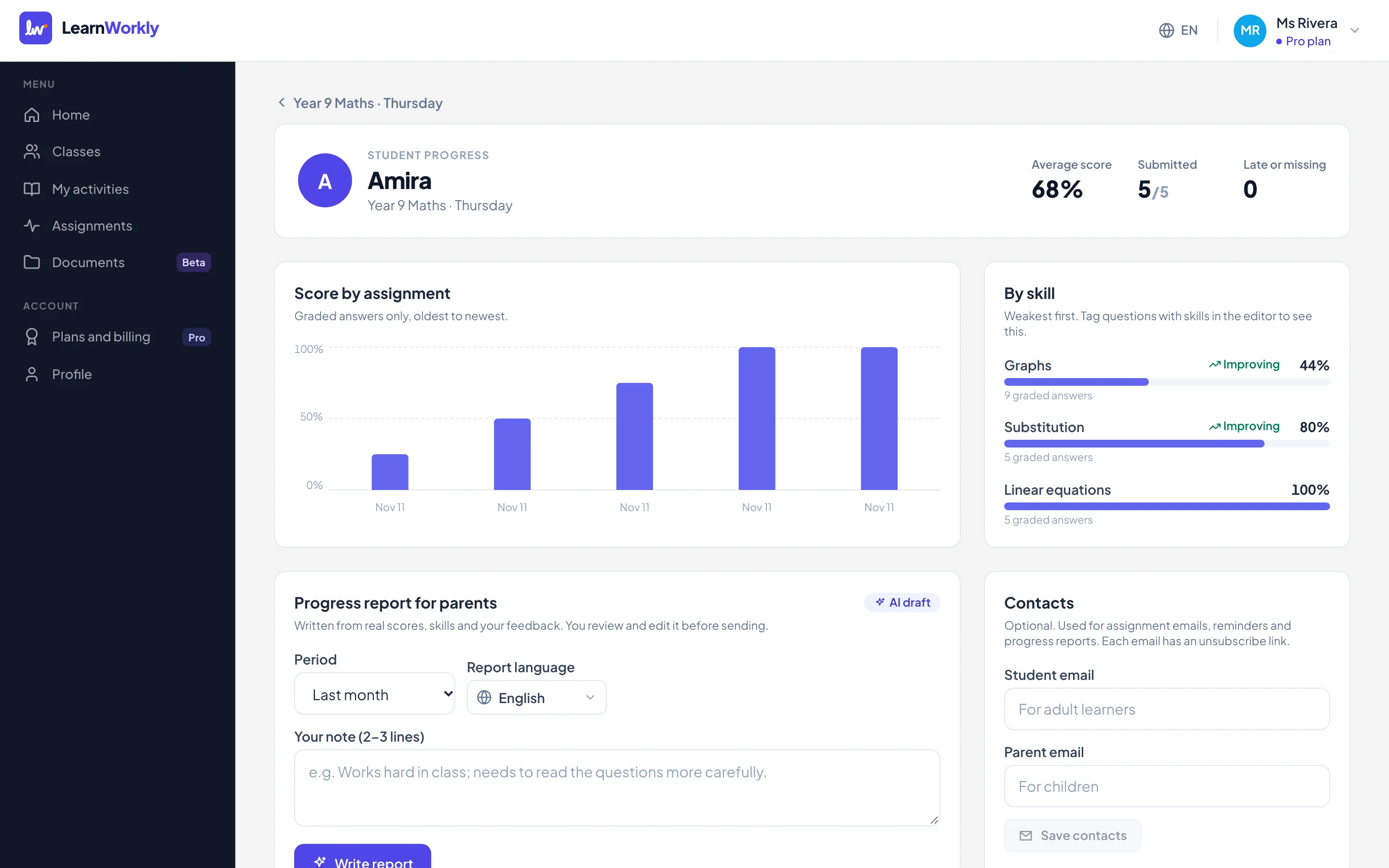
LearnWorkly keeps that record for you, and its progress reports for parents turn the scores and skills into a first draft: you add your own comments, edit anything you like, and send it to a parent email you added with their consent. Nothing is sent until you have reviewed it.
Before you send
A quick checklist for every report:
- Does every “improved” point have a number or an example?
- Are there no more than two “next” points?
- Is the home action specific enough to do this week?
- Would the student be happy to read it too?
If the answer to all four is yes, the report is ready. Most parents will read it in under a minute, and that minute is often what keeps them confident that the tutoring is working.