How much to charge for tutoring in the UK: a practical guide
How much to charge for tutoring in the UK: what published rate data shows, how to work out your own hourly rate, group prices, packages and raising rates.
LearnWorkly team7 min read

Working out how much to charge for tutoring in the UK is harder than it looks. Charge too little and you burn out teaching forty hours a week to cover your bills. Charge too much without being able to show results and families quietly drift away. This guide looks at what published rate data actually says, what pushes a rate up or down, and how to calculate a price that works for you and that parents feel is fair.
What tutors in the UK charge: the published data
There is no official national figure for tutoring rates in the UK. The best data comes from tutoring marketplaces that publish the prices their tutors list, and they disagree quite a lot. Here are two recent sources, checked on 11 November 2026:
- FindTutors (UK Private Tuition Price Report 2026, based on 38,602 tutor listings) gives a national median of £20 an hour in person and £24 an hour online. GCSE Maths sits at £20 in person and £25 online; primary at £25 for both.
- Tutorful (rates listed for online lessons in October 2026, published 29 October 2026) says most families pay between £43 and £54 an hour. Its averages include £44 for primary maths, £47 for 11+ maths, £46 for GCSE maths and £50 for A-level maths.
So depending on where you look, a typical UK tutor hourly rate runs from about £20 to about £54. The gap is not a mistake. The two sites attract different tutors (many students and new graduates on one, more experienced subject specialists on the other), and both measure advertised prices, not what tutors actually earn. Treat these numbers as the edges of the market, not as a target.
What pushes your rate up or down
Where you sit in that range depends on a handful of things families care about.
Level and exam stakes
Rates tend to rise with the stakes. In the Tutorful figures, 11+ and A-level tutoring cost more than primary, and families pay a premium in the months before entrance exams, GCSEs and A-levels. If you know a specific exam board inside out, or have marked for one, say so: it is exactly the reassurance parents are paying for.
Subject
Shortage subjects and specialist needs command more. Tutorful lists physics, economics and SEN support above its overall maths average, and French slightly below. On FindTutors, music lessons sit above most academic subjects. Supply matters as much as difficulty.
Experience and qualified teacher status
Neither source breaks rates down by qualification, so be wary of anyone quoting an exact “QTS premium”. In practice, qualified teachers, examiners and tutors with a long record of results can justify a rate towards the top of the range, and students or recent graduates usually start lower.
Online or in person
You might expect online lessons to be cheaper. In the FindTutors data the median online rate was actually higher than in person (£24 against £20). Online, you compete nationally, not just with tutors in your town, but you also save travel time, which you can turn into more paid lessons.
Location and London
FindTutors puts London in-person rates at the national median of £20, with Cambridge above and several cities, such as Leicester and Sheffield, below. For online tutoring, location matters much less: families choose you for your subject and results, not your postcode.
How much to charge for tutoring: calculate your own rate
Rate tables tell you what others charge. To know what you need to charge, work backwards from the income you want.
- Pick a target profit for the year. This is what is left after business costs, before tax.
- Add your costs. Software, resources, books, insurance, a DBS check, equipment, marketplace commission if you use one, and a share of your phone and broadband.
- Count your realistic teaching hours. Most tutors lose weeks to school holidays and quiet summers. Forty teaching weeks is a sensible starting point, not fifty-two.
- Remember unpaid time. Lesson planning, marking, messages with parents and invoicing do not appear on the timetable, but they come out of your week.
- Divide. (Target profit + costs) ÷ teaching hours = your minimum hourly rate.
A worked example: you want £28,000 profit, your costs are about £1,500, and you teach 20 hours a week for 40 weeks (800 hours). That is £29,500 ÷ 800, or about £37 an hour. Those 20 teaching hours will probably need another 8–10 hours of preparation and admin, which is why a rate that looks generous per hour is often modest per hour worked.
Tax and National Insurance as a self-employed tutor
Most private tutors are self-employed, so you pay Income Tax and National Insurance on your profit through Self Assessment. The government’s guide to working for yourself explains when you need to register and report your income. For the 2026 to 2027 tax year in England, the personal allowance is £12,570 and the basic rate of Income Tax is 20%; Income Tax bands differ in Scotland. On self-employed National Insurance rates, Class 4 is 6% on profits between £12,570 and £50,270, and Class 2 is treated as paid if your profits are £7,105 or more.
On the £28,000 profit above, that is roughly £3,086 of Income Tax and £926 of Class 4 National Insurance, leaving about £24,000. Set aside a share of every payment for your tax bill, and check the figures for your own situation, as rates and thresholds change each year.
Pricing group lessons
Small groups are the easiest way to raise your income per hour while lowering the price for each family. Price per student, not per lesson: each student pays less than for one-to-one, but the group pays more in total. For example, if you charge £40 for one-to-one, four students at £18 each brings in £72 for the hour.
Groups only work if every student still gets attention. If you cannot see what each student is doing, the quiet one falls behind and the parents notice. Keep groups small, set questions everyone answers at the same time, and use the answers to decide who needs help.
Packages, block bookings and cancellations
Selling lessons in blocks, such as a half-term of six or a term of ten paid in advance, gives you predictable income and gives families a reason to commit. A small discount for a block is common, but you do not have to offer one: the real value for families is a guaranteed weekly slot.
Write a cancellation policy before you need it and share it when someone books. A typical approach is that lessons cancelled with at least 24 hours’ notice can be rearranged, and later cancellations are charged in full. Put it in writing, apply it consistently, and allow yourself a little goodwill for genuine emergencies.
Raising your rates
Review your prices once a year, usually before September. Give existing families at least a month’s notice, explain the change briefly and without apology, and consider keeping current students on their old rate for a term while new students pay the new one. If your diary is consistently full and you are turning people away, your rate is probably too low.
Show progress to justify your price
Parents rarely leave a tutor because of the hourly rate. They leave when they cannot see what they are paying for. The tutors who charge most confidently are the ones who can show, with real work, that a student has improved.
That means keeping evidence: scores on regular short checks, examples of work from September and from now, and notes on what each student found hard. In LearnWorkly, each student has a progress page built from the work they actually did, with scores by assignment and progress by skill.
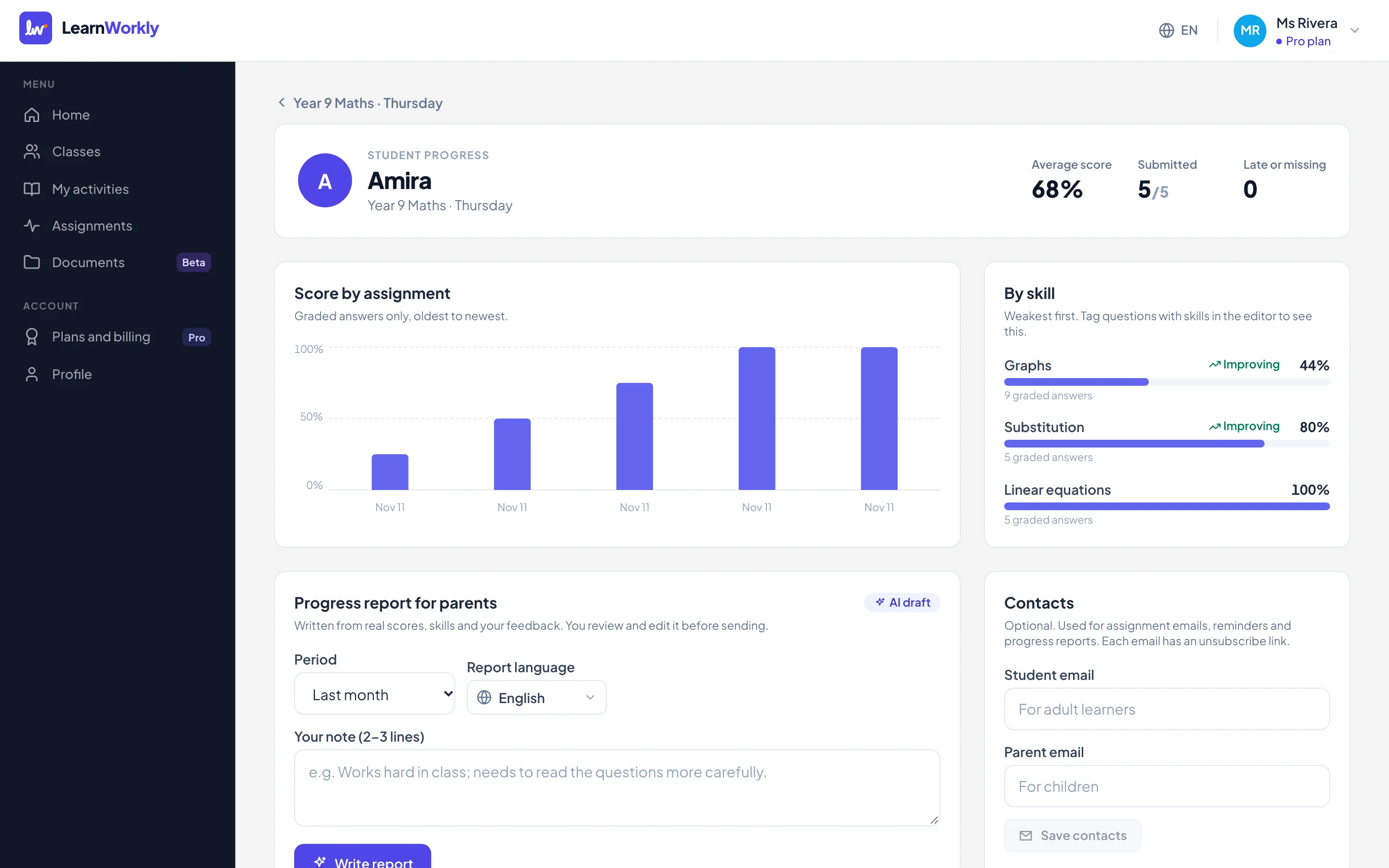
Share that evidence with families regularly. A short monthly update that names one skill that improved, with a score to back it up, does more for your rate than any discount. Our guide to writing tutoring progress reports parents actually read has a structure and example wording you can reuse. If you run a team, the same approach scales: see how it works for tutoring centres that want one way of showing progress across every tutor.
Summary
- Published UK rates range from about £20 to £54 an hour depending on the source; use them as limits, not targets.
- Level, subject, experience and exam stakes matter more than location for online tutoring.
- Calculate your own rate from target profit, costs, realistic teaching hours and unpaid time, and set money aside for tax and National Insurance.
- Price groups per student, sell blocks of lessons, and write a cancellation policy.
- Raise rates once a year, and back them up with evidence of progress.
If you want an easy way to collect that evidence in every lesson, try LearnWorkly. It is free for up to 10 students.